

Happy Soul Food Friday!
This week:
Given my penchant to say “yes” to the universe at my own peril, I get many queries about topics of import from all walks of life including from conscious business leaders, non-profit organizations, educators, influencers, wisdom traditionalists, students, neighbors and more…
In the last week, I got a real interesting set of questions with respect to communications specifically:
When working with leaders I talk about recognizing the difference between our assets and weapons.
As I see it, our two greatest assets as leaders are our (a) people and (b) self-reflection.
Our greatest weapon, however, is communication.
So,
1. How would you create a culture of communication in your brand, businesses, or leadership?
2. What would be significant communication hurdles you’d look to solve for by doing this?
Here is my response for the good or the order and, if appropriate, to disrupt the freakin’ disorder:
Note: Communications is my passion, discipline, and superpower so as Lynyrd Skynyrd would say, “I know a little ‘bout it, and baby I guess the rest” so please use what’s useful and discard the rest!
Welcome your thoughts too, Soul Food Community of several thousand strong, and got it going on…
Context (for me in the spirit of full transparency):
“Communication is the real work of leadership.”– Nitin Nohria
Even as a practicing lifetime peaceful warrior, steeped in the martial arts traditions for nearly 50 years, I am working hard to take the war language out of communications, as I don’t find it reflective of our current needs as individuals and as a culture, and unintentionally reinforces a command-and-control leadership/adversarial framework v. a collaborative/collective wisdom orientation.
There is a whole body of work around this that is way above my pay grade:
CNVC Founder – Center for Nonviolent Communication
My Biases and Orientation Up Front:
- Western Science and Eastern Wisdom Traditions, they work together
- Strengths-Based Frameworks not a Deficit Model, we are not motivated by our deficits
- Leadership is Inside Out not Outside In, its not performative, its authentic- own it!
- We > Me Collective Wisdom not just Individual Achievement, no one of us is as smart as ALL of us
- Cultural Competencies not just Success Strategies: “Culture eats Strategy for Breakfast” as Peter Drucker famously reminds us
Moving From Problem Solving to the “other” AI- Appreciative Inquiry:

Informed by Positive Organizational Scholarship:
Imagine a world in which almost all organizations are typified by greed, selfishness, manipulation, secrecy, and a single-minded focus on winning. Wealth creation is the key indicator of success. Imagine that members of such organizations are characterized by distrust, anxiety, self-absorption, fear, burnout, and feelings of abuse. Conflict, lawsuits, contract breaking, retribution, and disrespect characterize many interactions and social relationships. Imagine also that scholarly researchers investigating these organizations emphasize theories of problem solving, reciprocity and justice, managing uncertainty, overcoming resistance, achieving profitability, and competing successfully against others.
For the sake of contrast, now imagine another world in which almost all organizations are typified by appreciation, collaboration, virtuousness, vitality, and meaningfulness. Creating abundance and human well-being are key indicators of success. Imagine that members of such organizations are characterized by trustworthiness, resilience, wisdom, humility, high levels of positive energy. Social relationships and interactions are characterized by compassion, loyalty, honesty, respect, and forgiveness. Significant attention is given to what makes life worth living. Imagine that scholarly researchers emphasize theories of excellence, transcendence, positive deviance, extraordinary performance, and positive spirals of flourishing.
Positive Organizational Scholarship (POS) does not reject the value and significance of the phenomena of the first world view. Rather, it emphasizes the phenomena represented in the second world view. A focus on competition and profitability in the first world view, for example, is crucial for understanding organizational survival and success. The second world view merely calls attention to phenomena that represent positive deviance—phenomena that have received limited scholarly attention in organizational studies. Most organizational theories and empirical research have, heretofore, adopted assumptions and variables that are more typical of the first world view than the second.
—
That said, I love assets and consider communications a meta competency that transcends and informs other skills that are critical to conscious and authentic leadership.
I consider the trifecta of skill sets, mindset, and heart set to be the building blocks for leadership from within (intrapersonal) and communication a meta competency for connecting, engaging, and influencing others (interpersonal)
This might be all semantics to you, but language matters to me!
With that said here goes…
How would you create a culture of communication in your brand, businesses, or leadership?
- Assess present state
What is the climate/culture now?
What are the positive deviants already modeling and behaving into the future state?
Is the future state a compelling vision that everyone knows, owns, and is energized by?
Are those modeling the heart/mind/skill sets being affirmed and recognized?
“Leadership is the art of mobilizing others to want to
struggle for shared aspirations.”
—Jim Kouzes and Barry Posner: The Leadership Challenge
- Define future state in the language of your tribe
Having values like trust and integrity or competencies like communications and a service orientation are great but define them in the context of what these actually look like in your enterprise with actual examples.
- Make these values a critical component of evaluative and developmental opportunities such as annual reviews, organizational goals, brand stories, etc.
For example, your annual review could have 3 parts; goals, values, and discretionary effort (weighted differently) but all assessed with periodicity. (That’s what we do at Mission Fed…)
- Use the Positive Org Scholarship criteria above to continue to help the individuals and org behave into the future state.
If Leadership is a skill, then by definition it can be taught!
Lead each gathering, meeting, training, with a “mission story” that incorporates these elements and integral to your brand experience and differentiation
What would be significant communication hurdles you’d look to solve for by doing this?
- Tone at the Top- are senior leaders modeling these behaviors or just asking others to do it? Am I doing it?
“Yesterday I was clever, so I wanted to change the world.
Today I am wise, so I am changing myself.” -Rumi
- Tolerance for Misalignment- tolerating poor communicators (typically a function of ego-myopia and self-interest v. collective interest) suggesting these are flexible criteria not sacrosanct
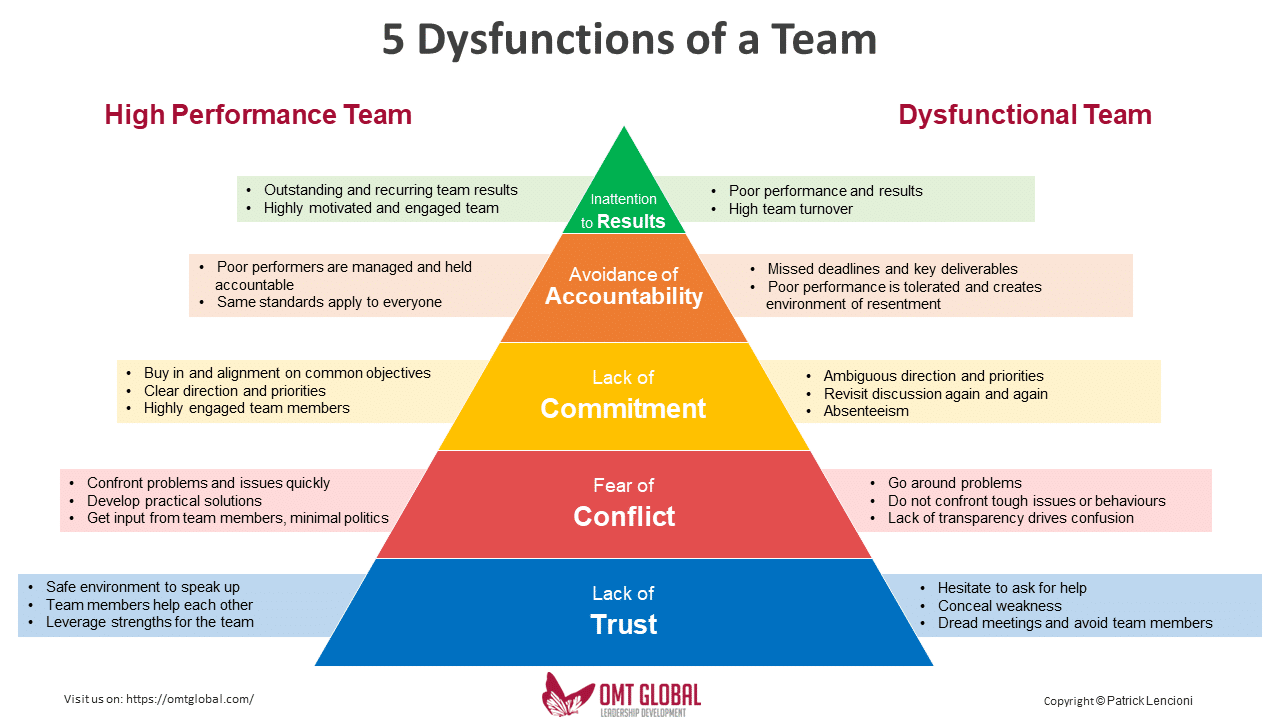
- Map against the 5 Dysfunctions of a Team (see below)
For example, a low trust environment breeds negative conditions that preclude moving up the ladder to commitment, accountability, and results.
“Preach the Gospel at all times.
And if you must, use words if necessary.” – St. Francis of Assisi
And then this hit my email box:
How Can You Recognize a Culture of Bad Leadership? Look for 5 Toxic Signs
Hope this provides some wind in your sails as YOU navigate turbulent seas, with your leadership chops at the helm, communication skills as your rudder, and trust at your keel…
Thaks this week go to Kai H and Jeff H for the prompt, thought leaders Dr. Danny F, Eric K, and Dr. Alan D, as well as Dr. Herb S and Dr. Dan H. at UC San Diego’s Comm Dept. for the foundational principles and practices in Communications.
Fair winds and Following Seas…
We do get by with a little help from our friends!
Love,
Neville
Linked-In: https://www.linkedin.com/in/nevillebillimoria
Facebook: https://www.facebook.com/nbillimoria
F: X!
“The most important thing in communication is hearing what isn’t said.”
— Peter F. Drucker
 Happy Soul Food Friday!
Excellent!