Turning the Spotlight on Community Leader Drew Schlosberg
For the first time in 25 years, I’ll be turning the tables and the spotlight by interviewing host Drew Schlosberg on his San Diego Union-Tribune Community Spotlight Show. Although I’ve been a frequent guest over the years representing Mission Fed and our involvement with the community, this is a special opportunity for me to ask Drew his thoughts about community engagement, cultivating a spirit of giving and Drew’s passion for making San Diego such a special place to live, grow and give back. Join this lively conversation and log in Wednesday, May 25 from 10:30-11am PST at wsRadio.com.
Go to wsRadio.com the day of the interview and click on Studio B to hear the show “live.” After the interview, the interview will be available on the channel’s website. Listen, learn and share the love of San Diego!
TheBeautyOfPainted Stairs Around The World
Abandoning the flat canvas of buildings, some street artists take to the stairs, transforming them into magnificent works of urban art. It doesn’t matter whether it’s with paint, plants, mosaics or wallpapers – the end goal is beauty, shared and enjoyed by all. This phenomenon is not a localized one and is happening all around the world. These are 20 of the world’s most stunning stairs:
Thanks this week go to Sue S, Drew S, Larry H, Terri M, the San Diego Nonprofit Community & Educators Everywhere!
Pay it forward!
Love,
Neville
“Love is what we are born with. Fear is what we have learned
here. The spiritual journey is the unlearning of fear and
the acceptance of love back into our hearts.” — Marianne Williamson
(I hear some of you save this to start the week off on Monday 🙂 )
This week:
A Letter Einstein Purportedly Wrote To His Daughter About The Universal Force of Love:
Teaching Tolerance: Which Uses of Technology Support Young People’s Development Better Than Say Using a Pencil, and Which Are in Fact Worse?
The Missing Flow in STEAM is R for Relationships!
Teaching Kids Philosophy Makes them Smarter in Math and English
If you are local…
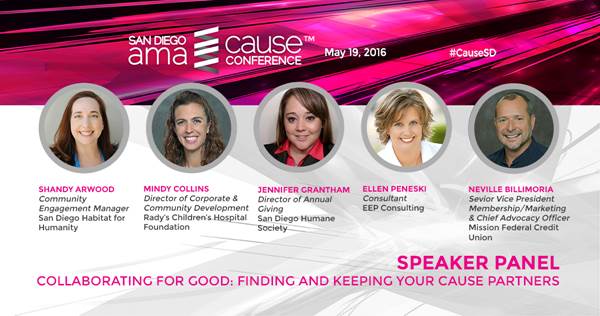
SD AMA Cause Conference May 19th 2016
Accelerate the Purpose Revolution.
MindFuelED on June 24-27: Leading EmpowerED Student-Centered Systems
A Letter Einstein Purportedly Wrote To His Daughter About The Universal Force of Love:
Note: Snopes disputes its authenticity but in the spirit of mythos v. logos, I choose mythos any day of the week!
Below is a letter that Albert Einstein wrote to his daughter about the universal force of love. The letter was released in the 1980’s along with over a thousand other letters that he wrote to different people.
“When I proposed the theory of relativity, very few understood me, and what I will reveal now to transmit to mankind will also collide with the misunderstanding and prejudice in the world.
I ask you to guard the letters as long as necessary, years, decades, until society is advanced enough to accept what I will explain below.
There is an extremely powerful force that, so far, science has not found a formal explanation to. It is a force that includes and governs all others, and is even behind any phenomenon operating in the universe and has not yet been identified by us. This universal force is LOVE.
When scientists looked for a unified theory of the universe they forgot the most powerful unseen force. Love is Light, that enlightens those who give and receive it. Love is gravity, because it makes some people feel attracted to others. Love is power, because it multiplies the best we have, and allows humanity not to be extinguished in their blind selfishness. Love unfolds and reveals. For love we live and die. Love is God and God is Love.
This force explains everything and gives meaning to life. This is the variable that we have ignored for too long, maybe because we are afraid of love because it is the only energy in the universe that man has not learned to drive at will.
To give visibility to love, I made a simple substitution in my most famous equation. If instead of E = mc2, we accept that the energy to heal the world can be obtained through love multiplied by the speed of light squared, we arrive at the conclusion that love is the most powerful force there is, because it has no limits.
After the failure of humanity in the use and control of the other forces of the universe that have turned against us, it is urgent that we nourish ourselves with another kind of energy…
If we want our species to survive, if we are to find meaning in life, if we want to save the world and every sentient being that inhabits it, love is the one and only answer.
Perhaps we are not yet ready to make a bomb of love, a device powerful enough to entirely destroy the hate, selfishness and greed that devastate the planet.
However, each individual carries within them a small but powerful generator of love whose energy is waiting to be released.
When we learn to give and receive this universal energy, dear Lieserl, we will have affirmed that love conquers all, is able to transcend everything and anything, because love is the quintessence of life.
I deeply regret not having been able to express what is in my heart, which has quietly beaten for you all my life. Maybe it’s too late to apologize, but as time is relative, I need to tell you that I love you and thanks to you I have reached the ultimate answer! “.
There is more and more attention these days on the need for better Social/Emotional Learning (SEL) in our schools. The research shows that when students have a higher EQ (Emotional Intelligence), they learn more, have less problems at school, and are happier. Yet we do very little in the classroom to facilitate SEL. Often the teacher’s excuse is “I don’t have enough time.” There is evidence though, that if a teacher makes the initial time investment for SEL, they actually end up with more academic learning time, as the class flows more smoothly in general because of it. Yes, first we realized we needed to re-emphasize STEM (Science, Technology, Engineering, Math) in the classroom, then we realized the Arts were just as important, so we had STEAM. This article advocates that now what we really need is an emphasis on STREAM, adding the much needed R in for Relationships. Education Transformations (www.edtrans.org) offers the necessary tools for teachers to be able to bring SEL into their classrooms.
Accelerate the Purpose Revolution. Register for the Cause Conference today.
MindFuelED on June 24-27: Leading EmpowerED Student-Centered Systems
“If you are interested in issues related to leadership and cutting edge approaches to the work of transforming education I want to make you aware of an exciting event that may be of interest to you and your ecosystem. The Department of Education Studies at UCSD is partnering with The Core Collaborative and Prism on an event called MindFuelED on June 24-27, with a commitment to expand student-centered systems while practicing mindfulness in an effort to empower all educational leaders to be more grounded, connected, focused and authentic.
In addition to learning the basics of neuroscience and mindfulness, teams will learn how to leverage social networks to expand student-centered systems. Teams and individuals will also be able to choose from a variety of learning opportunities that all weave core ideas of mindfulness and the role of relationships.
Topics include:
Student-Centered Assessment
Scaling up with Success Criteria: Leveraging Student Ownership
The Power of Peer Assessment & Student Goal Setting
Student Centered Instructional Coaching
Student Centered Assessment for English Learners
Student Centered Assessment in the Secondary Classroom
Leading Powerful Student Centered Change in Systems
They are partnering with The Teaching Channel who does work with a video-enabled collaboration platform that enables teachers and instructional leaders within a state, district, or school to work together to improve effectiveness.
Work collaboratively to transform the teaching and leadership space in the region and beyond to be more mindful, collaborative, and networked.
Please note the cost covers all training, materials, and meals.
Thanks this week go to Larry H, Mica P, Susan Y, Alan D and the whole team at UC San Diego Ed Studies, Carla SG & Jackie H, Marlaine C, Volunteers at the SD AMA Cause Conference, and Mindful, Student-Centered Educators Everywhere!
Pay it Forward!
Love,
Neville
“Everybody is a genius.
But if you judge a fish by its ability to climb a tree, it will live its whole life believing that it is stupid.”
Mother’s Day is celebrated in different countries and cultures to honor the selflessness and love of mothers since 1900s. The American incarnation of Mother’s Day was created by Anna Jarvis in 1908 who later opposed to the extreme commercialization of the festival. Motherhood is the highest and most selfless human connection. Make this Mother’s Day special!
“Accelerating the Purpose Revolution” :Attend the San Diego AMA Cause Conference May 19th:
Bringing together hundreds of local and national companies and nonprofits that are “Accelerating the Purpose Revolution” on May 19th
The Cause Conference is the west coast’s largest cause and purpose-driven marketing conference. It has become a driving force for social good and community impact. Check out the lineup of cause marketing leaders and brands like Aaron Hurst, author of The Purpose Economy.
I hope to see you at #CauseSD!
Thanks this week go to Victor P, John C, Alan D, Bea B, David P and Moms Everywhere!!
Neville
“To live is the rarest thing in the world. Most people exist, that is all.”—Oscar Wilde
There are three things, once one’s basic needs are satisfied, that academic literature points to as the ingredients for happiness: having meaningful social relationships, being good at whatever it is one spends one’s days doing, and having the freedom to make life decisions independently. But research into happiness has also yielded something a little less obvious…
Everybody Dies, but Not Everybody Lives:
Connection: The Key to High Performance Leadership with Daniel Goleman
We were talking about the huge difference between leaders who connect with the people around them, and those who do not…
Earth Day Vs. Passover: 5 Lessons for Great Storytelling
With Passover coinciding with Earth Day this year, it’s a rare opportunity to see how these two observances compare when it comes to delivering their message through the timeless art of storytelling…
Enjoy a God’s Eye View of Iconic Sights and Places in San Diego to Kickstart Your Weekend!
If you are local…
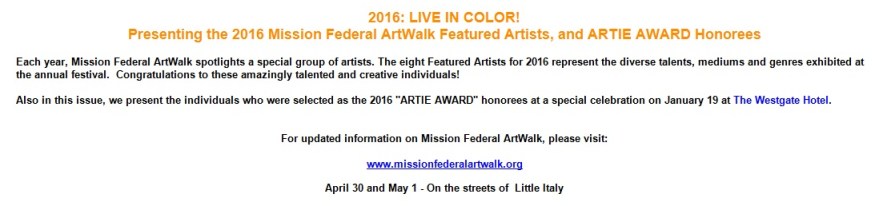
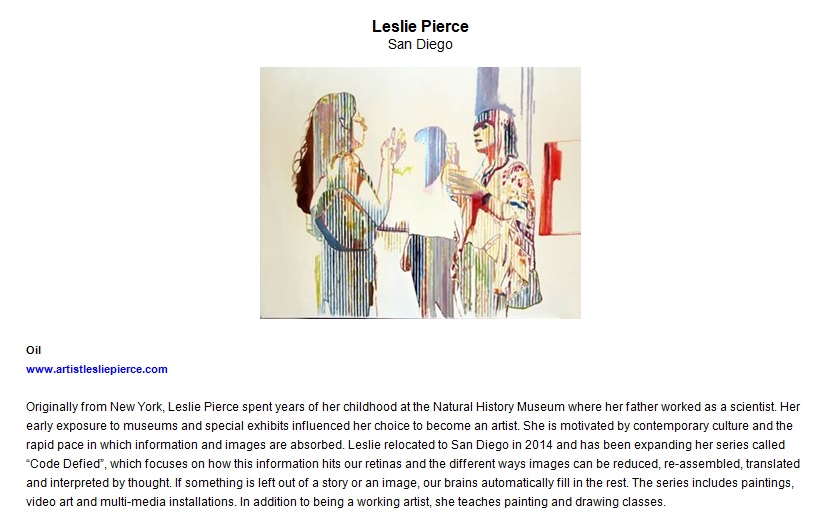
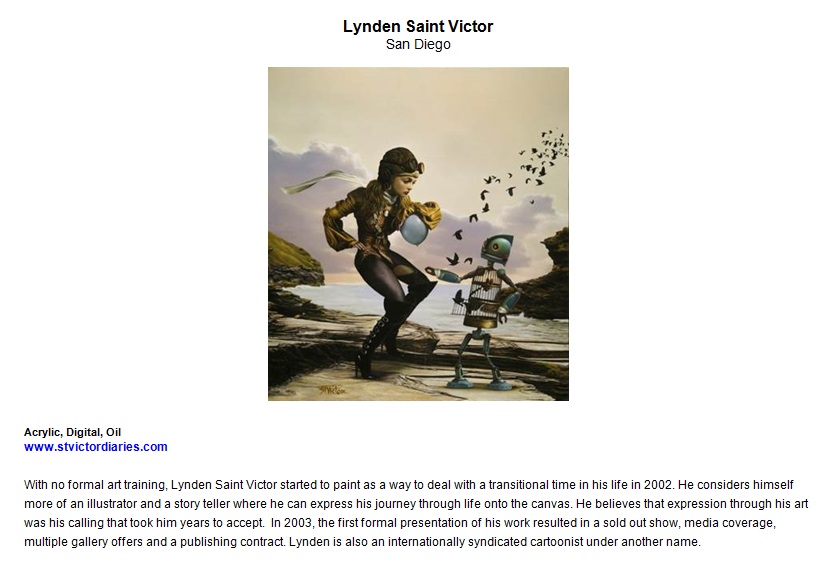
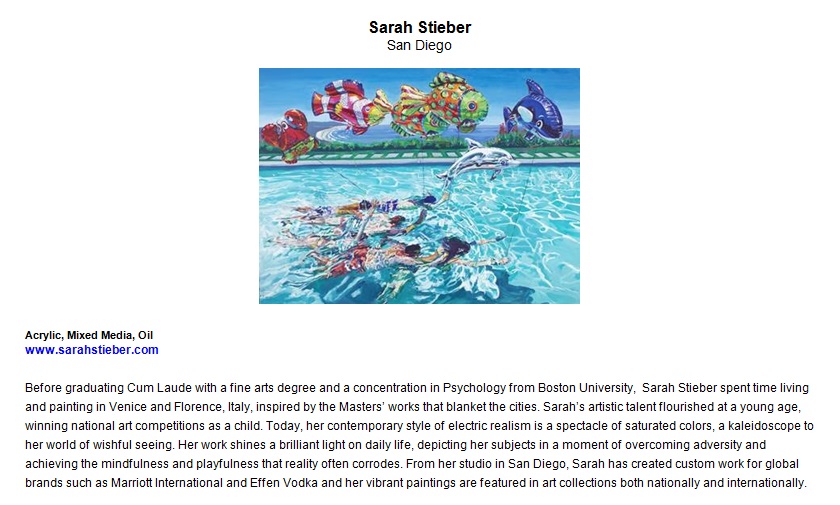
Enjoy Mission Fed ArtWalk April 30th & May 1st 2016:
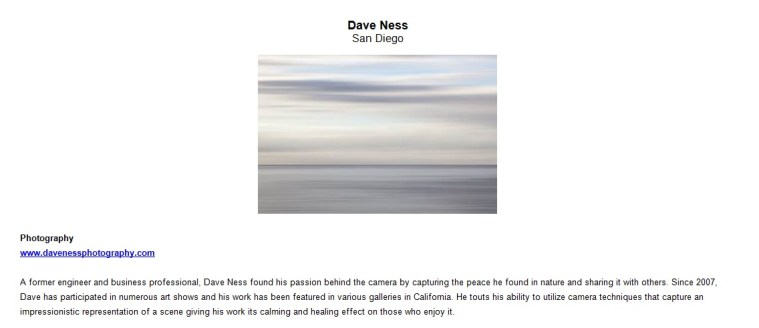
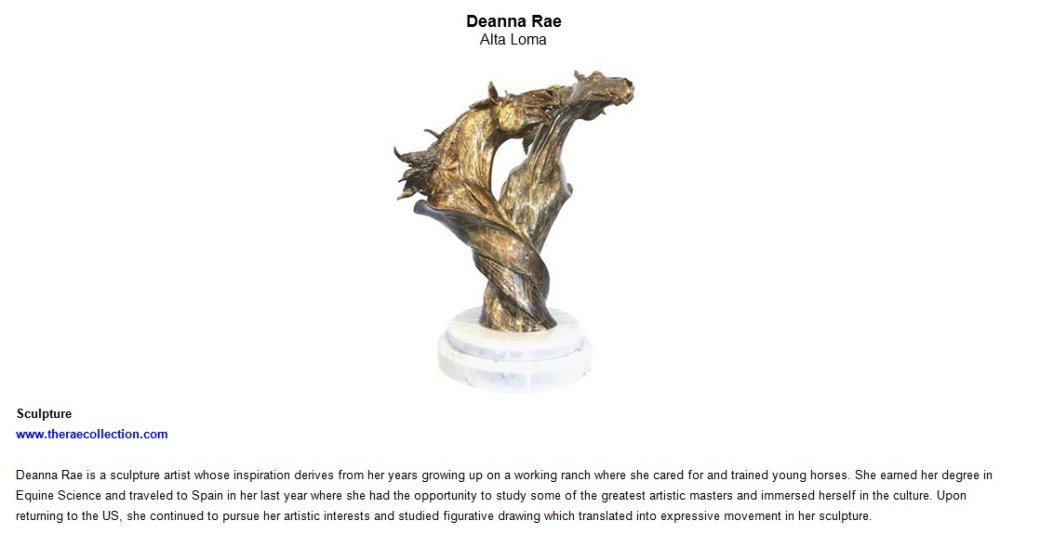
2016 Mission Federal ArtWalk Featured Artists
2016 Mission Federal ArtWalk / ArtReach ARTIE Award Honorees
L to R: Adam Moyer, Jennifer Borba Von Stauffenbert, Angela Carone, Kevin Hellman
The Artie Awards give recognition to some extraordinary individuals in San Diego, for their support of arts and culture in our city.
Presented by Mission Federal ArtWalk:
Alan Ziter has worked tirelessly to create a dynamic arts and culture district in San Diego. His vision and hard work for the past 13 years have made The Arts District at Liberty Station a home to some of the city’s most exciting visual and performing arts groups. Many of the artists you’ll see at the festival in April have their studios at Liberty Station. Alan has long been an activist in the arts in San Diego. Before NTC he directed the San Diego Performing Arts League and co-produced the memorable Bravo San Diego event for many years at The Westgate Hotel.
Angela Carone covers arts and culture for KPBS and is the author of Culture Lust, the station’s arts blog. She is known for her insightful and honest on-air and online reporting on arts and culture in the region. Her fresh and authentic way of covering the visual and performing arts has both informed and entertained us, while keeping arts and culture in the spotlight in San Diego.
Jenn Borba Von Stauffenberg is the president of Olive PR Solutions. As much as good public relations pros like to remain in the background, Jenn has more than earned this recognition not only for taking our festival public relations efforts to a new level, but also for supporting so many other visual arts programs in San Diego and nationally. She is truly passionate about visual art, and she has been investing in local artists for years by purchasing their works, holding art shows in her Little Italy office and more.
Kevin Hellman is the publisher of San Diego Citybeat. Each year, for both of our annual festivals, Kevin comes up with a brilliant lineup of musicians who volunteer their time to entertain festival attendees. Kevin has played this role for ArtWalk events since 2005. When Kevin calls, musicians listen! But this is just one of the many ways he shares his love of music. He is president of the San Diego Music Foundation and he works with numerous local events to help them with their musical lineup.
Presented by ArtReach:
Adam Moyer founded Knockaround, a local company centered around a sunglasses line that was simultaneously practical and stylish. In 2014, Adam invited ArtReach to partner with Knockaround to take a design exercise called Class Acts into local schools. The premise was to give students a basic overview of the design process for sunglasses, to allow each student to create their own design and to pick one student-designed pair to manufacture and sell. All proceeds go to participating schools and to ArtReach; over $30,000 so far. Adam personally invests time and enthusiasm in this program. He makes philanthropy seem effortless and fun, but also very intentional. We thank Adam for supporting visual arts education in San Diego.
Thanks this week go to Larry H, Ron M, Marlaine C, Amon R, Lisa B and Artists of Life Everywhere!
Please pay it forward!
Love,
Neville
@ NevilleB108
“When you are inspired by some great purpose, some extraordinary project, all your thoughts break their bonds.
Your mind transcends limitations, your consciousness expands in every direction, and you find yourself in a new, great, and wonderful world.
Dormant forces, faculties and talents become alive, and you discover yourself to be a greater person by far than you ever dreamed yourself to be.”
Soul Food Friday Fans: I am excited to share that I am now also on Twitter, focusing on topics such as 21st Century Leadership, Education, Civic Engagement and Social Capital Optimization. Please tweet me @NevilleB108
This week:
A Story about Everybody, Somebody, Anybody and Nobody on Earth
Restoring Civility in America and Beyond:
Are You a Prisoner of Your Preferences?
Can We Get Beyond the Left/Right Politically Polarizing Game?
On Race:
Obama Effect Triggers More Nuanced Conversations on Race
On World Cultures:
Persian Cuisine, Fragrant and Rich With Symbolism
29 Clever Drawings Will Make You Question Everything Wrong With The World:
RIP Prince!
A Story about Everybody, Somebody, Anybody and Nobody
This is a story about four people whose names are Everybody, Somebody, Anybody and Nobody.
There was an important job to be done and Everybody was asked to do it.
Everybody was sure that Somebody would do it.
Anybody could have done it, but Nobody did it.
Somebody got angry about that, because it was Everybody’s job.
Everybody thought Anybody could do it, but Nobody realized that Everybody wouldn’t do it.
It ended up that Everybody blamed Somebody when Nobody did what Anybody could have done…
Are You a Prisoner of Your Preferences?
Can We Get Beyond the Left/Right Politically Polarizing Game?
Consider the third option or the “Purple Tent” – politics worthy of our kids, that might well be the salvation for a broken system that has deliberately and insidiously focused our attention- the currency of influence on:
Confirming what we believe instead of Learning what could be
Winning instead of building Relationships
Position-taking instead of genuine Problem-solving
Me instead of We
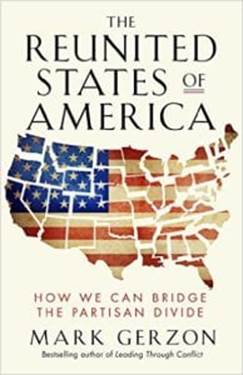
Instead of playing into a daily media bombardment of incivility and (hu)man’s inhumanity to man on the daily news feeds that perpetuates sensationalizing the very worst of the human experience under the auspices of an election, this week I was blessed to be introduced to a powerful antidote by my friend Dr. Ken Druck in an authentic conversation with Mark Gerzon, author of The Re-United States of America: How We Can Bridge the Partisan Divide at USD http://www.markgerzon.com/ at the Restoring Respect’s 5th Annual Conference April 18, 2016 https://www.sandiego.edu/events/detail.php?_focus=52725
Mark used his most recent book as a framework to reset the table about the possibilities and promise of a “third narrative” beyond the platitudes of partisan politics:
“Although we come from opposite ends of the political spectrum, we believe our country needs to come together. “The Reunited States of America: How We Can Cross the Partisan Divide” will help us do that. It reconnects us to our country’s motto – ‘out of many, one’ – and helps us meet the challenge of reuniting the country that we both love.” – Grover Norquist, president, Americans for Tax Reform & Joan Blades, co-founder MoveOn.org and Living Room Conversations
Mark is a thoughtful systems thinker, seasoned mediator on political bridge-building and was originally trained as a family therapist.
Mark shared that the first system we know and grow into is our nuclear family, and true to form, today’s leading political candidates, ALL are shaped and playing out scripts that were formed and informed in their family of origin; where their blueprint for success and ideologies were decidedly shaped and molded to play out the script we all see enacted in the media debacle of today.
Looking at this current election cycle through the lens of our kids (who ARE watching us keenly), we can’t help but feel disillusioned that this certainly can’t be the best we can do as a democratic nation. Reality TV has taken on a decidedly unreal tone…
Oddly, while we are lamenting this nonsensical farce and media circus, Gen Next are making conscious choices about a “third narrative”, beyond liberal or conservative or Democrat or Republican where “Americans are working together across the aisle to find common ground to solve our most pressing problems.”
Can we learn from them?
Millennials self-report 60% independent and aren’t buying either side of this political rhetoric BS media machine.
Both liberal and conservative camps are fueled in the $ billions, but voices in the center (like the ones listed at the end of this blogpost) are struggling for funding and by extension exposure
Millennials hang out with their friends on opposite sides of an issue and seem to get along just fine, and don’t get why we are so vitriolic, mean-spirited and self-centered, clinging to our monolithic views like mental life rafts.
Student debt in the $ Trillions is waking them up to the fact that the current model is simply not working for them!
Consider the third option or the “Purple Tent” – politics worthy of our kids, that might well be the salvation for a broken system that has deliberately and insidiously focused our attention- the currency of influence on:
Confirming what we believe instead of Learning what could be
Winning instead of building Relationships
Position-taking instead of genuine Problem-solving
Me instead of We
The US presidential elections on November 8, 2016, will be the 58th quadrennial U.S. presidential election. Yet sadly, our electoral system has turned this like others into an endless campaign cycle that focuses only on winning on November 8th instead of what actually happens after that date.
While some may argue that every civilization goes through rises, declines and ultimately extinction, and this is just the beginning of the decline of America’s greatness as a nation, when it comes to civility this is not just about America- ethnocentrically- or even about all of us just speaking respectfully to one another, it is arguably the keystone determinant in our survival as a species.
One could make a good argument that the confluence of exceeding our adaptive and cognitive threshold, our reliance on confirmation bias (the bias bubble) and our selective application of attribution theory leave us no choice but to capitulate to current realities and behave into these polarizing roles.
Yet others have a more positive aspiration…
We can foster a deeper dialogue and not have to go down this proverbial rabbit hole
Here are some thoughts gleaned from our gathering with a small but mighty group of civic leaders:
Self-Awareness
Can we collectively burst the ‘bias bubble’, snap out of the social hypnosis and become aware of our own distortions?
Smart people think they know everything
Intelligent people accept there are things they don’t know
Wise people realize they must remain open to the possibilities of what they don’t know what they don’t know
Which one of these are you and me?
Redefine Self with an Open Heart
We must move from antiquated feudal and industrial age EGO-systems to 21st century connected era ECO-systems that focuses on learning, relationship and problem-solving together
Serve Community by Creating and Fostering Safe Space
If we are in fear and self-protection mode, we are unable to learn
Master facilitators create safe space for authentic conversations to occur and we need these now more than ever…
If you want to Lead through Conflict you need:
Integral Vision– Committing ourselves to hold all sides of the conflict, in all their complexity, in our minds
Systematic Thinking– Identifying all (or as many as possible) of the significant elements related to the conflict situation and to understand the relationship between these elements
Presence– Applying our mental, emotional and spiritual resources to witnessing and transforming the conflict
Inquiry– Asking questions that elicit essential information about the conflict that is vital to understanding how to transform it
Conscious Conversation– Becoming award of our full range of choices about how we speak and listen
Dialogue– Communication in order to build trust and knowledge that maximizes the human capacity to bridge and innovate
Bridging– Building partnerships and alliances that cross the borders that divide an organization
Want to go deeper?
Here are some resources and links for you, your family and extended community to see the world through a more balanced lens that doesn’t create political bipolar behavior fraught with incivility:
http://www.livingroomconversations.org/ Living Room Conversations is a new, open-source project exploring the power of revitalized civil discourse in America.
http://www.bridgealliance.us/ We are the Bridge Alliance – a rising American tide of conservatives and liberals, centrists and moderates, business owners and workers, students and retired persons, diverse in age, color, faith and orientation. We have come together in civility, respect, and goodwill to solve problems together. Together, we can become a powerful and positive voice in the American political landscape advocating “Country Before Party.”
Alternatively, Google: trans-partisan, bipartisan and civility and see where your personal exploration takes you…
Too busy?
It is only the future of our country and our planet at stake…
Obama Effect Triggers More Nuanced Conversations on Race
When President Obama was elected did we usher in a new era of racial harmony. No… but many of us are having a more nuanced conversation about this subject
An ancient Zoroastrian festival of the spring equinox, Nowruz has been celebrated continuously for at least 3,000 years, more than a thousand years before the region’s Muslim conquest. It predates most of the holidays Americans celebrate today yet shares many of the same traditions.
“Emancipate Yourself from Mental Slavery, None but Ourselves Can Free Our Minds” – Bob Marley
This week:
It’s Emancipation Day! Guess that’s why our taxes aren’t due until April 18th but did you know…
A Metaphor for the Impact of Early Education That Will Make You Smile: This is darling
A Nobel Laureate’s Education Plea: Revolutionize Teaching Because it is Almost Unethical to Teach Any Other Way!
A Focus On Student’s Emotion: Focusing on Academic Rigor and Test Scores Does Not Have to Be at the Expense of Social & Emotional Lessons, and if it is What Have We Really Taught?
“Thrivers and Strugglers”: A Growing Economic Divide where roughly three in four American households are the “strugglers”… Three demographic drivers – age/birth year, education and race/ethnicity – increasingly matter for building wealth and financial security
If you are local…
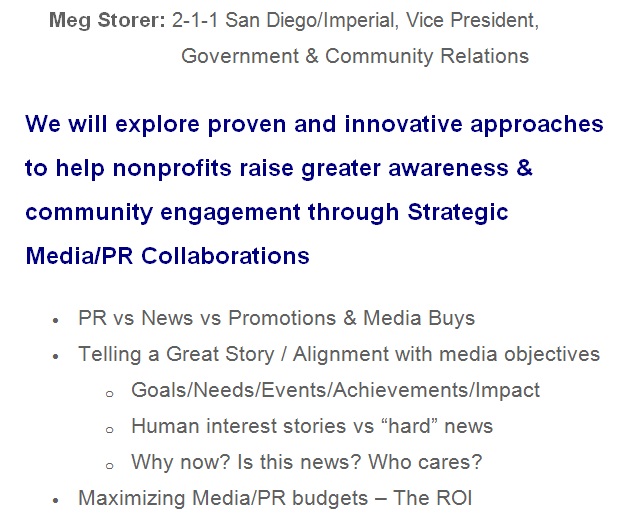
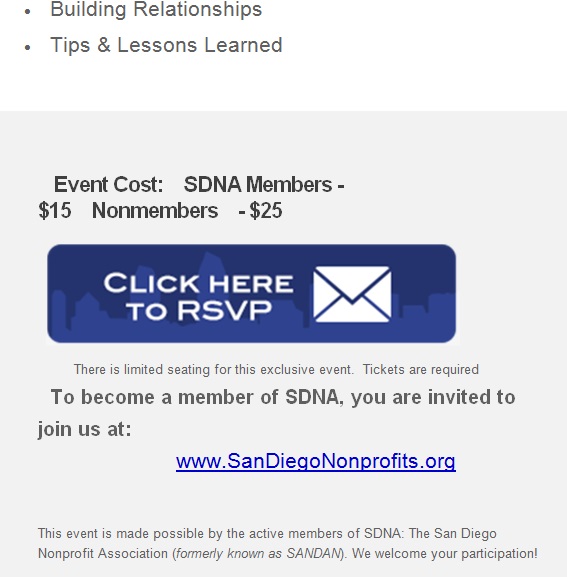
SDNA In The Know: Amplify Awareness & Engagement Via Media & PR Apr 21, 9am
Restoring Respect – 5th Annual Conference on Restoring Civility to Civic Dialogue – “Educating Civility”
Redemption Song- Bob Marley
It’s Emancipation Day:
Guess that’s why our taxes aren’t due until April 18th but did you know…
Thrivers and Strugglers: A Growing Economic Divide: Three demographic drivers – age/birth year, education and race/ethnicity – increasingly matter for building wealth and financial security
By Ray Boshara, Federal Reserve Bank of St. Louis
Bravo to MacKenzie. When she was born, she chose married, white, well-educated parents who live in an affluent, mostly white neighborhood with great public schools. She also chose her birth year wisely, making sure that she graduated from college and entered the job market when the economy was rebounding from the Great Recession. Thanks to the wealth and financial savvy of her parents, MacKenzie graduated from a private, four-year selective college debt-free, giving her many career options as well as the ability to start saving for a home and retirement.
Because of her great “choices,” MacKenzie is likely to accumulate wealth and achieve financial health over her lifetime. She and her parents belong to the roughly one in four American households we can call “thrivers.”
But too bad for Troy. Despite being just as bright as MacKenzie, he chose nonwhite parents who never married and live in a poor, highly segregated neighborhood with lousy public schools and few opportunities to be involved in music, sports and civic activities. Troy’s young, hard-working, conscientious mother was never able to start college. In order to manage the frequent ups and downs in her financial life, she has accumulated debts to family members and credit cards. She also lacks the know-how and networks to get Troy on a college-bound track, something his school fails to do as well. And Troy unwisely chose to finish high school just as the Great Recession was getting underway. So, finding any job, let alone a decent-paying one with benefits, eludes him.
Because of his bad “choices,” Troy is not likely to accumulate much wealth or feel financially healthy over his lifetime. He and his family belong to the roughly three in four American households we can call “strugglers.”
Research from the Center for Household Financial Stability at the Federal Reserve Bank of St. Louis suggests that three demographic drivers – age/birth year, education and race/ethnicity – increasingly matter for building wealth and financial security. MacKenzie and her family’s efforts to build wealth are buoyed by these demographic tailwinds, while the lack of them creates headwinds that hamper Troy and his family’s efforts to succeed financially.
Let us consider each of these characteristics, or drivers, separately.
Race, Ethnicity and Wealth
Beginning with race or ethnicity, a few facts stand out.[1] First, the wealth gaps are disturbingly large and the rankings have persisted since 1989. White families rank first, followed by Asian families, Hispanic families and then black families. With the exception of Asians, the median net worth of all groups in 2013 was about the same as in 1989; the Great Recession wiped out most of the post-1989 gains. However, prior to the recession, whites and especially Asians had seen dramatic increases in their wealth. Since 2010, they have seen their wealth begin to grow again, while the wealth of blacks and Hispanics has continued to decline. (See Figure 1.)
Also, wealth disparities are starker than income disparities. Median wealth for Hispanics and blacks is about 90 percent lower than that of whites. In contrast, median income of Hispanics and blacks is only 40 percent lower. This suggests these two groups may have had few opportunities to “convert” their diminished incomes into wealth, such as through home ownership and retirement plans. And although one would expect age and education to help explain the persistent differences in wealth accumulation across racial and ethnic groups (whites are generally older and better educated than blacks and Hispanics), our research shows that the wealth gap is largely unchanged even among equally educated, similarly aged whites and nonwhites. Stated more starkly, education does not appear to be an equalizer, at least in terms of wealth. Therefore, other factors must be in play, including early childhood experiences, parental influences and, of course, deep and historical discrimination against blacks and other minorities.
Education and Wealth
Not surprisingly, the association between a family’s education and its wealth is very strong and has become stronger with time, leading to large gaps in wealth by level of education.[2] Only families with college degrees or higher have seen their wealth increase since 1989 (even though all groups saw their wealth decline in the Great Recession). Those lacking a high school diploma saw their wealth plummet 44 percent between 1989 and 2013, while families with a high school diploma saw their wealth decline 36 percent. Meanwhile, families with a two- or four-year college degree experienced a 3 percent increase since 1989, while the wealth of those with advanced degrees spiked 45 percent.
Notably, however, the correlation between education and various measures of economic and financial success does not represent causation. That is, the college degree itself may only partially explain differences in wealth. The degree serves as a marker of many other factors also correlated with educational attainment, such as native ability, family background, marriage patterns (i.e., the tendency of college graduates to marry other college graduates), being read to as a child and the likelihood of receiving gifts or inheritances.
Age and Wealth
Finally, let’s look at age or, more precisely, year of birth. Of course, older families are expected to have more wealth than younger families. But what we are observing is something deeper, even historical.[3] To our surprise, age is the strongest predictor of balance sheet health, even after accounting for race and education. Americans in their 20’s and 30’s lost the most wealth in the recession and have been the slowest to recover. The wealth of younger adults is concentrated in home ownership, which suffered greatly during the recession. Younger adults also have significant mortgage and consumer debts, and few liquid assets. In addition, they faced severe labor market challenges during and following the recession. But this is not just a recession story; it’s a generational, more troubling story: An American born in 1970 is projected to have 40 percent less wealth over their lifetime than an American born in 1940. Clearly, some larger economic and social forces are underway, reshaping economic opportunity in the U.S.
Policy Implications
In a world where uncontrollable factors – birth year, race/ethnicity, parents – and education – a choice, but influenced by all of the above factors – appear to increasingly matter for building wealth and financial success, three policy responses hold particular promise:
1. Give greater weight to demographic factors in targeting public resources.
Although income has been the primary benchmark for safety net and tax benefits, our research suggests that age or birth year, race or ethnicity, and education must play a greater role in targeting scarce public resources. The U.S. has dedicated massive resources, ruled on issues such as desegregation and voting rights, reduced discrimination in housing and lending practices, built schools and universities, subsidized higher education for disadvantaged students and otherwise striven and often succeeded in helping less-educated and minority families move forward. College attendance rates have been steadily rising, and minorities now hold more elected offices than ever, for example. However, millions of these families remain economically vulnerable; in some ways, they are now even more fragile, given growing economic penalties on less-educated and minority families. Therefore, broad, ambitious efforts to invest in these families must not only continue but be strengthene d.
With regard to age, the U.S. has invested less during the earlier years of life, and the country lags in per capita spending on children compared with other advanced nations. In fact, the U.S. social contract has relied on the ability of younger workers to finance the safety net of older Americans. However, because that social contract is now threatened, and given the challenges facing younger Americans, smarter and more robust investments earlier in life are merited. For example, could we consider more of an age-based social contract, where newborns, school-aged youth and young adults starting their careers and/or families receive a public benefit to help them build human capital and net worth? These investments could be modeled on the “pay it forward” idea, where public investments in individual families (through, for example, no- or low-cost tuition plans) are paid back later in life directly through earnings or, indirectly, through greater productivity and economic growth.
2. Create ways for families to save when children are young and integrate savings plans into other early interventions.
In the assets field, there is a growing body of evidence that savings accounts and assets early in life lead to better outcomes later in life. The Assets and Education Initiative finds that “early liquid assets (ones the household has when the child is between ages 2 to 10)… work with children’s academic ability to influence whether they attend college. The effect is stronger for low-income children than it is for high-income children.”[4] Two studies using randomized trials in the SEED OK experiment in Oklahoma show that Child Development Accounts (CDAs)[5] have a positive impact on social development for children around age 4. This effect was greatest in children in disadvantaged groups.[6] A second study finds that CDAs increase the psychological well-being of mothers, and again the effect was greatest among disadvantaged groups.[7]
Consideration should be given to strategies that integrate CDAs and similar early asset strategies into the fabric of other interventions aimed at young children. For example, a CDA might be offered to every mother who enrolls in a prenatal health program, or to every child entering Head Start or a preschool program. Reading programs might offer an education-focused CDA. Pell grants might be “front loaded” so that income-eligible children at age 5 receive a small portion of their Pell in a CDA, which would then reduce their Pell grant at age 18 accordingly. The College Board has, in fact, advanced a similar idea. It will be difficult, in my view, for stand-alone CDA interventions to reach all economically vulnerable children. Accordingly, integrating early assets and early childhood interventions holds promise for both impact and scale.
3. Help parents and other adults build liquidity and financial assets.
Of course, we cannot build family financial health and well-being by investing only in kids and ignoring their parents and other adults. Accordingly, we should adopt a “two-generation” approach.[8] Struggling families need a range of sound balance sheet investments, including better banking options, credit repair, more college and retirement savings, fewer debts and paths to sustainable homeownership and small-business opportunities. But one intervention in particular cuts across family balance sheets and promotes both financial stability (a family’s first priority)[9] and economic mobility: creating liquidity.
The need for liquidity is well documented. The Federal Reserve Board’s Survey of Household Economics and Decision making (SHED) finds that an unexpected expense of just $400 would prompt nearly one-half of all households to borrow funds, sell something or simply not pay at all.[10] Fed data also show that the top savings priority for families is emergency or liquid savings, yet only about half of all Americans have such savings. And CFED finds that 44 percent of households are “liquid asset poor.”[11]
When families have more liquid savings, they can better manage their cash flows and volatility; rely less on friends, family and payday lenders to meet cash shortfalls; have better banking options; and save for education, training or a small business, as well as a home or apartment in a better neighborhood. In my view, no intervention better cuts across the health of U.S. family balance sheets – and does more to promote family stability and mobility – than building emergency savings and liquidity.
To be most effective, these three policy recommendations must be integrated into other efforts. Although one or two interventions, including the most promising ones, are not likely to erase enormous gaps in education, earnings or wealth, they are likely to significantly reduce the financial health disparities experienced between future thrivers like Mackenzie and strugglers like Troy.
Restoring Respect – 5th Annual Conference on Restoring Civility to Civic Dialogue – “Educating Civility”
The 2016 election season has already proven to be one of the most divisive and vitriolic in recent American history. From candidates’ personal attacks to paralysis and dysfunction in national government, the price tag of incivility, and resulting failure to reach political consensus, has never been greater. Join other concerned members of our community in an ongoing discussion about how to restore respect to the local and national civic dialogue. Explore ways to better educate the next generation of citizens and community leaders on how to better build our American community.
Decades of research by organizational scientists, psychologists, sociologists, economists and demographers show that socially diverse groups (that is, those with a diversity of race, ethnicity, gender and sexual orientation) are more innovative than homogeneous groups.
Do not believe everything you read online, especially not on April Fool’s Day.
News sites and even some brands have taken to April 1st for years as a day to have some fun with the unsuspecting, and that trend doesn’t show any sign of slowing down.
Here’s a compilation of some of 2016’s attempted hoaxes that you can scroll through and pick ones that look interesting:
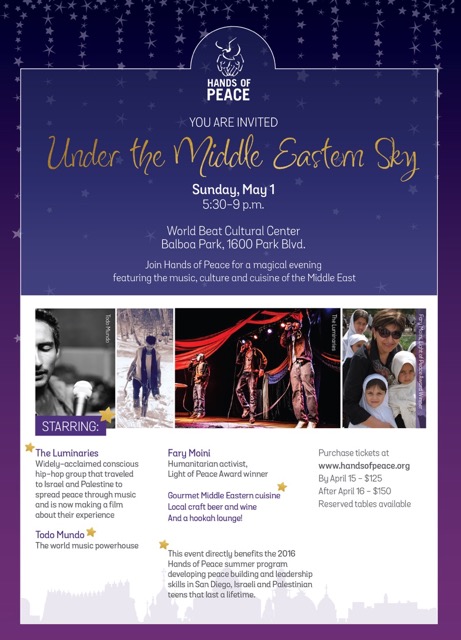
Hands of Peace “Under the Middle Eastern Sky” Creating Teen Peacemakers on May 1st:
Hands of Peace is an organization that empowers young people from around the world to learn leadership skills so they can be peacemakers and leaders in their home communities.
To see teens from the Middle East and America go through such a transformation- from confused, frustrated, tormented young people- to seeing the humanity in others and realizing their own power as leaders has given many great hope for the future.
Please help share information about this cultural festival that includes music by the Luminaries (conscious hip-hop!) and Todo Mundo, gourmet food, local wine and beer, a hookah lounge and silent auction .
Tickets are available at www.handsofpeace.org. and the pre-sale price goes up on April 15 so sign up right away!
Keys to Amplifying Awareness & Engagement through Media & PR with the SDNA on Thursday April 21st 9-10:30am @ 2-1-1
Thanks this week go to Linda K, Drew S, Parker H, Robin M, Kim L, the SDNA, and all members of the social sector making our world better!
Please pay it forward…
Love,
Neville
“You don’t have to be great at something to start, but you have to start to be great at something.”
This week it is not about making a fool of anyone but revealing some uncommon facts to awaken your soul…
Let’s get in the mood for April Fool’s Weekend with:
How an Eight-Year-Old Boy Invented a New Word That Quickly Became the Top Trending Topic in Italy
With his teacher’s help, the student wrote to the Accademia della Crusca – the institution that oversees the use of the Italian language – to ask for their opinion…
“this is worth more than a thousand Italian lessons”
Waterborne diseases kill more children every single year than AIDS, Malaria, and All World Violence COMBINED!
Thirst Project is an international organization whose mission is to “build a socially-conscious generation of young people who END the global water crisis.”
The Simplest Thing You Can Do to Improve Your Life Now:
What if there was one very simple, extremely simple, ridiculously easy thing you could do that would dramatically improve how you see the world and how people see you?
What if this one very easy thing lowered your blood pressure, relaxed your muscles, reduced aches, pains and headaches and increased your lifespan?
What if this absolutely painless and actually pleasurable simple thing also made you much more attractive to others and increased your actual opportunities in both your career and your life?
What if this perfectly natural thing that you already know how to do is proven to reduce loneliness, attract new friends and deepen and trust and intimacy with the most important people in your life?
And what if this one amazing, astonishing, stunning thing has been tested in numerous studies over decades to produce a mountain of evidence that it nearly instantly puts you in a better, more optimistic mood and does the same for the people around you?
Well, it’s true. Global research from universities in England, the Netherlands and Germany using fMRI brain scans combined with decades of psychological studies confirm that all these are the beneficial effects of smiling!
That’s right I said smiling. It is especially true for people who make smiling a habit.
As I said, this is simple…but it’s not easy. How many people do you notice are in the habit of routinely smiling? I would guess not too many. That’s perhaps the reason that people who smile a lot are socially magnetic…they stand out.
It’s not natural for most of us to control our moods. Indeed, our moods mostly control us. But they don’t have to. We are not the victims of our feelings.
Steve is friend of mine who lives across the country who sends me quotes, ideas and personal reviews of new books he is reading almost every day. Recently he sent me a quote from Neville Goddard that made a profound point (I am paraphrasing). “If you don’t like what you see in the mirror, don’t break the mirror instead, change your face.”
I think it is often too easy to feel overwhelmed by the difficulties of our lives and the cruelties of our world. It’s easy to get lost in a whirlpool of blaming and complaining until we lose all sense of our immense personal power.
I am not naive enough to think that life-storms are not real, or that deep suffering is all in our mind. But what I am sure of is that we don’t have to take it. We can change our circumstances, our jobs, and our relationships. Maybe not immediately. And certainly not impulsively. But with wisdom, discipline, and time we can all write new chapters in our autobiographies. The most important thing is to believe we can.
When you look in the mirror smile. Smiling improves everything.
Please join us at the EPIC Mastermind Experience on April 7 & 8, 2016 – Four Point Sheraton Hotel – San Diego, CA. I’m honored to be one of the presenters who are committed to helping you make your business and personal dreams come true. This event is different because you will be receiving personalized support from a community of heartfelt and successful leaders. Click here for more information. www.EpicMastermindExperience.com – Sign up today. Use the special discount code when checking out to receive a substantial discount- Discount Code EPIC197.
We Won’t Get Fooled Again!
Let’s take you out with a high energy blast from the past…
Thanks this week go to Marlaine C, the BBC, NPR, Ron A, Will M , Larry H, the Epic Mastermind Team, and Everyone Who is Cool Playing the Fool!
Pay it forward…
Love,
Neville
“You don’t have to be great at something to start, but you have to start to be great at something.”
Part of what made people like Martin Luther King Jr., Nelson Mandela, Mother Teresa and Mahatma Gandhi legendary were the words they spoke.
Just think about it…
Words of hope can lift whole nations. And words of hate can destroy entire races.
Victimspeak will diminish your personal output while leadertalk will galvanize it.
1 Amazing Human Spirit: “My Body Switched Off and My Imagination Switched On”
Paddy Slattery’s Amazing Human Resilience Story on BBC created a compelling “parking lot moment for me and I simply couldn’t leave my car and had to hear the whole story…
Paddy’s story begins at around the 26:33 mark in this edition.
100 Iconic Lines and Memories That Will Live Forever:
100 movie clips in 10 min that make you want to see them all again and again….
1,000 Times More Unique!
On a night-time dive near Hawaii, 2 divers were found by a bottle-nose dolphin and it started to swim around them over and over again.
When looking closer, one of them discovered the reason for this strange behavior – the dolphin had a fishing line hooked around it, hindering its ability to swim.
They cut him free, and the dolphin swam away. The fact that a dolphin would come to humans for help maybe evidence of its’ intelligence, as most injured animals would never come close to a human. This is amazing to watch 3:14 Minute Video – Best Viewed Full Screen:
Thanks this week go to Andrea M for sleuthing a story, Robin S for framing the topic, Paddy S for leading by example and Larry H for the 100 movie clips and dolphin encounter!
Here is to your masterpiece and order of magnitude!
Pay it Forward!
Love,
Neville
“If you are depressed, you are living in the past.
If you are anxious, you are living in the future.
If you are at peace, you are living in the present.”
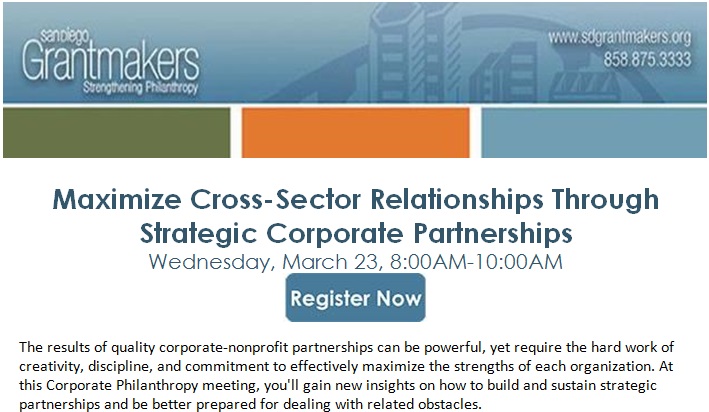
(9:00 AM-11:30 AM at MOPA – Museum of Photographic Arts)
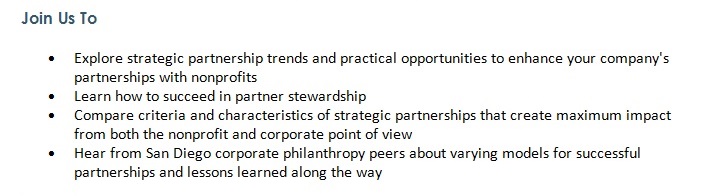
A unique opportunity to meet the funders! Panel Discussion, Q&A and Meet & Greet with representatives of financial institutions with charitable giving programs. Panelists include Neville Billimoria of Mission Federal Credit Union, Wendell French of Wells Fargo, and Rocky Ewell-US Bank.
The Museum of Photographic Arts has graciously made their state-of-the-art auditorium available for this event.
They are located in Balboa Park, 1649 El Prado, San Diego, CA 92103.
Thanks this week go to Marlaine C, Peter B-S, Larry H, grant makers and grant receivers everywhere!
Pay it Forward!
Love,
Neville
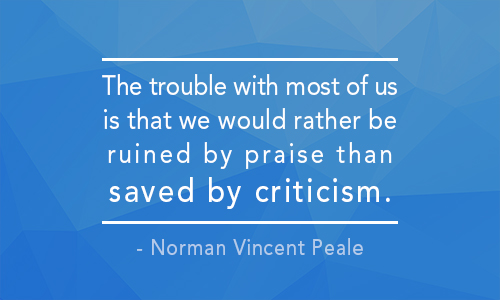
“Thomas Edison dreamed of a lamp that could be operated by electricity, began where he stood to put his dream into action, and despite more than ten thousand failures, he stood by that dream until he made it a physical reality. Practical dreamers do not quit.”— Napoleon Hill





















 Happy Soul Food Friday!