
Happy Soul Food for April Fools Week!
This week:
- Medicine is Not Always Found in Bottles, Make America Kind Again
- Why Leadership is Essential to Your Career
- The 4th Estate and the Importance of Free Speech
- Precluding Attacks on Education
- Managing Stress and Practicing Self-Compassion
A couple of pranksters broke into the lavatory in the executive branch and stole all the lavatory equipment. White house spokesman was quoted as saying, “We have absolutely nothing to go on!”

“The true price of leadership is the willingness to place the needs of others above your own.
Great leaders truly care about those they are privileged to lead
and understand that the true cost of the leadership privilege comes at the expense of self-interest.”
Leadership Matters!
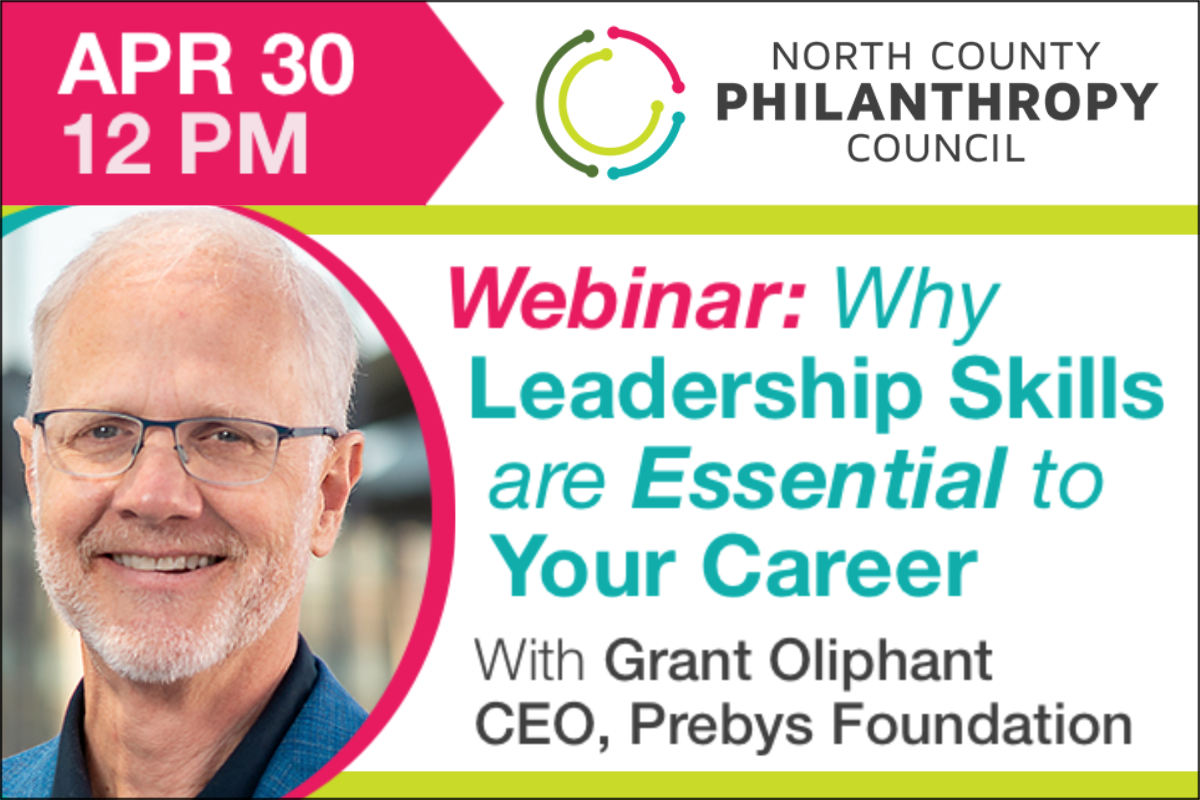
With the disruption of the historical coexistence between Govt and the Nonprofits, many are cutting budgets, laying off staff, lying low, and taking a look-and-see response to the dynamic situation we find ourselves in. Let’s not lose the forest for the trees. Here is an opportunity to listen in and leverage our collective spirit in service of the greater good, regardless of your political preferences.
An eye for an eye makes the whole world go blind.
Join Grant Oliphant, CEO of the Prebys Foundation, as we explore why leadership matters more than ever and investing in future leaders is critical.
You can view the session description here- https://secure.ncphilanthropy.org/event.jsp?event=145&
And you can register here- https://secure.ncphilanthropy.org/eventReg.jsp?event=145&
Please spread the word! We are better together…
For Context, here is Grant’s Blog post from a couple of weeks ago:
San Diego Needs to Protect Civil Society and Shared Values in Challenging Times | Prebys Foundation
The Fourth Estate and the Importance of Free Speech-
The Role of Journalism in a Democracy:
| One of the most sacred principles of The Atlantic, as laid out in its 1857 founding statement, is that the magazine deals with politics as they are. We will report the truth, no matter who is in power. The Atlantic, our founders wrote, “will deal frankly with persons and with parties, endeavoring always to keep in view that moral element which transcends all persons and parties, and which alone makes the basis of a true and lasting national prosperity.” This principle of course came into play when our editor in chief, Jeffrey Goldberg, realized that he had accidentally been included in the “Houthi PC small group” Signal chat about an imminent attack on Yemen. Goldberg at first worried that it was a hoax. When he realized it was real, he left the group, called the officials involved, and then published a story. After they falsely accused him, and The Atlantic, of having made things up, we published a second story with a direct transcript of the chat. Some of the exchanges that occurred last week might have bewildered our magazine’s founders. I suspect that if you had texted Ralph Waldo Emerson “👊🇺🇸🔥” after a strike in Yemen, he might have tossed his phone into Walden Pond. But the general principle was one that everyone involved in The Atlantic for the past 168 years has understood: Our job is to report on the most important issues of the day—fairly, accurately, and patiently—no matter what anyone in power says. We take these responsibilities, and our legacy, very seriously at The Atlantic, and we are very grateful for the support that you, our readers, have given us in the past week. In that spirit, I’d like to invite you to a subscriber-only conversation with Goldberg this Thursday, April 3. You can find more details on the virtual event below. I hope you’ll join us. Nicholas Thompson CEO of The Atlantic |
Public airwaves
 | By Benjamin Mullin I cover the media. |
There is no reason, Republicans say, for the government to fund NPR and PBS.
Last week, G.O.P. members of Congress, led by Marjorie Taylor Greene, flayed the leaders of both organizations for what they said was partisan programming. “You all can hate us on your own dime,” Greene said. The next day, a Republican introduced a bill to end all government support.
What would happen to public broadcasting if Republicans succeeded? In today’s newsletter, I’ll explain.
NPR
The specter of government abandonment has haunted public radio for so long that executives drafted a secret plan for the worst.
In February 2011, NPR assembled a 36-page document that detailed exactly what would happen if the Treasury stopped cutting checks to the Corporation for Public Broadcasting, the government-backed company that supports NPR and PBS. The document, which has not previously been reported, is bleak. It describes a precarious radio system that will bear the blow poorly, with consequences for listeners across the nation.
“Most NPR member stations operate at, or barely above, break-even,” it begins. A cutoff would cause up to $240 million to vanish and up to 18 percent of roughly 1,000 member stations to close. The Midwest, the South and the West would be affected the most. Nationwide, up to 30 percent of listeners would lose access to NPR programming.
NPR provides national coverage, but the independent member stations across the country get most of the money devoted to public radio. That makes them more vulnerable than the national headquarters, which says it gets only 1 percent of its budget from Congress. (It gets a bit more from local stations that pay for its programming).
 |
| NPR’s headquarters in Washington, D.C. Eric Lee/The New York Times |
What are these local stations doing? Take WEKU, a constellation of 10 FM stations with headquarters in Richmond, Ky., that broadcast to nearly 1.5 million residents. For people who don’t have access to broadband internet, WEKU is one of the few reliable sources of information when emergencies happen.
Floods swept through the state earlier this year. “Our transmitters stayed on the air, and we were broadcasting information to residents in Pikeville on where they could get fresh water, how they could deal with FEMA,” said Mike Savage, the station’s director and general manager. NPR’s audience has fallen by about 28 percent since 2020. But many of the residents who still tune in really need the information.
After the floods, someone from Hazard, Ky., emailed Savage to say that public radio was her only source of vital information. “We were her lifeline because they had no power, they had no cell service, they had nothing except for listening to our public radio station and getting information every day,” Savage said.
NPR can weather the funding cut, its document predicts, thanks in part to aggrieved listeners: Executives predict a sudden boom in donations if Congress defunds it, as listeners rush to defend their favorite programs. But they will likely give more in big-city markets.
PBS
 |
| A taping of “PBS NewsHour.” Jared Soares for The New York Times |
Public television in the United States would likely be in worse shape because PBS receives much more of its budget — about 15 percent of $373 million — from the federal government.
There’s something quirky about PBS: Many of the shows operate their own businesses. So marquee programs like “PBS NewsHour” and “Nature” would need to find money elsewhere, such as from donations or syndication.
But again, the member stations, which rely more on public funding than the national organization does, would bear the brunt. Those stations use the money to cover local affairs, often in a news desert. Alaska Public Media, for instance, is a PBS and NPR member station with several local affiliates in rural areas. Those team up with newspapers, including The Daily News-Miner in Fairbanks and The Juneau Empire, to cover state and local governments.
That’s crucial, in part, because reliable sources of information are disappearing from smaller towns across America, said Paula Kerger, the chief executive of PBS. “There isn’t an economic model that would compel commercial broadcasters to have outlets strewn across the state where the population is so sparse,” she said.
Public and broadcasting
It’s not an issue that moves large voting majorities. About a quarter of American adults believe that public media should be defunded, and 43 disagree, according to the Pew Research Center.
In the past, members of Congress have been persuadable. In 1969, as Congress contemplated reducing funding for public media, members invited Fred Rogers, the creator of “Mister Rogers’ Neighborhood,” to testify. Lawmakers sat rapt as he quoted a song he’d written about keeping anger under control.
One legislator said that Mister Rogers had given him “goose bumps” and acknowledged that the testimony had saved the day. “Looks like you just earned the $20 million.”
A half-century later, the party that controls Congress is tuning those arguments out. When Mister Rogers’s testimony came up at the hearing last week, one witness said that Congress shouldn’t have listened to him.
“In the end, we will remember not the words of our enemies, but the silence of our friends.”— Dr Martin Luther King Jr
Opinion | This op-ed could lead to me being deported from the US:
I could never have imagined that writing a critical piece about the government could put me at risk of deportation.
This op-ed could lead to me being deported from the US | Berna León | The Guardian
America Must Not Remain Silent. A Time Comes When Silence is Betrayal:
The song remains the same…
For 3 days starting June 6, 2020, paddle outs were held by Paddle for Peace take a stand against racism and honor the lives of George Floyd and Breonna Taylor. The largest paddle out San Diego has ever seen was held at Tourmaline Surfer’s beach followed by 2 additional paddle outs in Ocean Beach and Windansea beach. Community members from all different backgrounds came out to stand on the beach in solidarity or to paddle out alongside other surfers. This day changed the lives of many people and sparked a movement that still holds strong.
Precluding Attacks on Education-
Attacks on education are any intentional threat or use of force—carried out for political, military, ideological, sectarian, ethnic, or religious reasons—against students, educators, and education institutions.
Tufts PhD student taken into custody and visa ‘terminated,’ school says
Rumeysa Ozturk is a Turkish national, according to her lawyer, Mahsa Khanbabai.
Tufts PhD student on visa arrested by immigration authorities, school says – ABC News
Yale professor who studies fascism fleeing US to work in Canada
Jason Stanley, who says grandmother fled Berlin with his father in 1939, says US may become ‘fascist dictatorship’
Yale professor who studies fascism fleeing US to work in Canada | US universities | The Guardian
Sue or hold back? The University of California does both as it faces Trump’s wrath
Stay informed, effortlessly. Get a sharp, nonpartisan digest of the state’s most important issues, once a week.
University of California struggles to respond to Trump – CalMatters
“Between stimulus and response there is a space.
In that space is our power to choose our response.
In our response lies our growth and our freedom.”
–Viktor Frankl
Managing Stress and Practicing Self-Compassion-
Harvard doctor: How to reduce stress and silence your inner critic
While the source of Americans’ stress varies the effects are the same. We become unproductive, unmotivated, and our own worst critic.
Dr. Aditi Nerurkar: How to reduce stress and silence your inner critic
U.S. Surgeon General Vivek Murthy Says Your Overall Happiness and Mental Health May Come Down to 7 Words
One simple habit that’s like rocket fuel for your impact and well-being. Mar 29, 2025, Vivek Murthy, US surgeon general. What’s the real meaning of happiness? And how do we actually experience it—not just in fleeting moments, but in a lasting, sustainable way? Too often, happiness is mistaken for an emotion we chase: joy, excitement, pleasure. But those are just the symptoms of happiness, not the root of it.
Harvard-trained expert: 3 quick habits for a happier life—in less than 20 mins/day
Most people are wrong about what makes them happy, says Yale psychology professor and Harvard-trained happiness expert Laurie Santos. Here’s what to do about it.
Happiness expert Laurie Santos: Quick habits for a more fulfilled life
Adversity doesn’t breed character, it REVEALS it!
Thanks, this week go to Staci R, Laura H, Grant O, and all of you choosing facts and faith over fear and freezing while fostering advocacy, allyship and agency when it matters most!
Love,
Neville
“The day will come when, after harnessing space, the winds, the tides and gravitation,we shall harness for God the energies of love.
And on that day, for the second time in the history of the world, we shall have discovered fire!”–Pierre Teilhard de Chardin
 Happy Soul Food Friday!