Happy Soul Food Friday!
As we celebrate the power and impact of the scientific revolution, do you ever wonder about its limitations?
Externalities and intangibles:
The traditional and conventional (scientific) method of isolating, isolating, isolating to the point of identifying that predictive variable seems to me a necessary but insufficient condition, as we increasingly realize that real learning, understanding, and breakthroughs occur through a confluence of variables not just due to a single one.
Today’s progressive researchers in many fields are shifting their mindset to accommodate several moving variables, realizing that often it is the investigative model that needs shifting (shift happens) in order to rightly understand the relationship between the variables not just the variable itself -in creating change.
Isolating must be replaced by CONNECTING as 21st century frameworks replace feudal and industrial age models in the migration from:
- Hierarchical to Networked Organizations
- Centralized to Distributed Leadership
- Independence to Interdependence
- Specialization to Cross-trained Generalists
- Organizations rigidly driven by Policy and Procedures to Organizations guided by Simple, Shared and Flexible Parameters
This leverages the Collective Intelligence of the System and unleashes the Social Capital banked within!
My epiphany for this week (and I welcome your reaction/response) is that in my estimation, most conventional approaches don’t account for externalities, if they don’t fit the model.
Clearly, this is not a new idea.
Many thought leaders in their respective fields have eloquently stated this in their own ways.
Here are some examples:
- “An organizations “intangible assets” represent more than 75% of its strategic value” – Kaplan and Norton of Balanced Scorecard fame in Strategy Maps
- “Culture eats strategy for breakfast” – Peter Drucker Management Guru and the leader in the development of management education
- “In organizations, real power and energy is generated through relationships and the capacity to form those relationships is more important than tasks, functions, roles and positions.” –Margaret Wheatley, world renowned management consultant and organizational behaviorist focused on change, leadership and the learning organization
- “Not everything that can be counted counts, and not everything that counts can be counted.” –Albert Einstein, the father of modern Physics
In today’s complex world, cross functional, multi-disciplinary approaches to solving real world problems is where it is at, and the externalities that you typically don’t count, might be the difference that makes the difference to actualizing your mission!
Real thought leaders are unafraid to really experiment, and when in doubt realize it is their model that is flawed- so they change the model.
“Cut the coat to fit the person. Don’t cut the person to fit the coat”
Please, don’t be a buzzard, bat, or bee…
THE BUZZARD:

If you put a buzzard in a pen that is 6 feet by 8
feet and is entirely open at the top, the
bird, in spite of its ability to fly, will
be an absolute prisoner. The reason is
That a buzzard always begins a flight from the ground
with a Run of 10 to 12 feet. Without space
to run, as is its habit, It will not even
attempt to fly, but will remain a prisoner
for life in a small jail with no top.
THE BAT:

The ordinary bat that flies around at night, a
remarkable nimble creature in the air,
cannot take off from a level place.
If it is placed on the floor or flat
ground, all it can do is shuffle about
helplessly and, no doubt, painfully, until it
reaches some slight elevation from which it can
throw itself into the air. Then, at once, it
takes off like a flash.
THE BUMBLEBEE:

A bumblebee, if dropped into an open tumbler, will
be there until it dies, unless it is taken out.
It never sees the means of escape at the
top, but persists in trying to find some way out
through the sides near the bottom.. It
will seek a way where none exists, until it
completely destroys itself..
PEOPLE:

In many ways, we are like the buzzard, the bat, and
the bumblebee. We struggle about with all our
problems and frustrations, never realizing that
all we have to do is look up! That’s the
Answer, the escape route and the solution to any problem! Just look up.
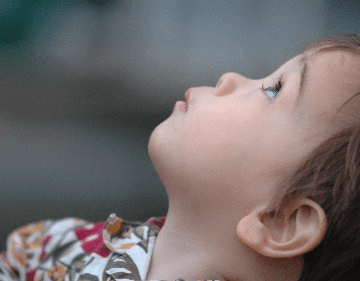
Sorrow looks back, Worry looks around, But faith looks up!
Live simply, love generously, care deeply, speak kindly and
trust in those who loves us.
“The best way to make your dreams come true is to wake up.”—Paul Valery
Speaking of externalities, another externality that is rarely valued and often misunderstood is Empathy
http://startempathy.org/blog/2013/04/most-powerful-empathy-learning-experience-baby-and-changemaker-school
—
One of my favorite and vastly undervalued externalities is Kindness
Enjoy this article with more on Conscious Capitalism:
Millennials spur capitalism with a conscience
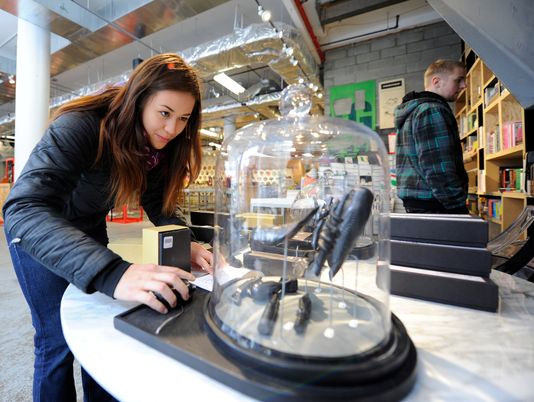
Seemay Hui and Billy Korman of Ft. Collins, Colo. shop at Treasure & Bond in New York City. (Photo: Robert Deutsch, USA TODAY)
Story Highlights
- More big companies are embracing kind acts that help people
- If the kindness is PR or marketing driven, it probably will backfire
- 72% of consumers would recommend a brand that supports a good cause
At a handful of Panera locations, down-and-out folks pay only what they can afford. Nordstrom recently opened a test store where all profits go to charity. Starbucks has three coffee shops where a big chunk of the money made helps the needy. This isn’t capitalism gone wacko. It’s capitalism with a conscience.
For decades, this kind of corporate kindness was the exception, but in the past few years, dozens of America’s biggest brands have embraced socially kind deeds as an unusually effective way to sell themselves to consumers, employees, even stockholders. Some are listening to their hearts — while others are listening to social-media chatter and creating consumable spin.
In either case, there is one particularly desirable audience that’s watching closely: Millennials. This trend-setting, if not free-spending group of 95 million Americans, born between 1982 and 2004, live and breathe social media and are broadly convinced that doing the right thing isn’t just vogue, but mandatory. With nearly a third of the population driving this trend, kindness is becoming the nation’s newest currency. “Companies can’t hide anymore,” says Ben Cohen, co-founder of Ben & Jerry’s, known for not only devoting a hunk of its profits to charity but also for supporting grassroots environmental and sustainability causes. Because everything they do becomes social-media fodder, he says, “forward-looking companies are starting to do less bad — and more good.”
In an ultra-transparent world, where information zips from Facebook to Twitter to Instagram, just about everything a company does is out in the open, says John Mackey, co-founder of Whole Foods, a ground-breaking company in local community support. “If everything you’re doing is seen,” he says, “it’s human nature to do things that people would approve of.”
But it’s no longer just outliers such as Ben & Jerry’s and Whole Foods doing the right thing. Big consumer brands such as Panera, Starbucks and Nordstrom are members in good standing of the Do-Gooder Society. More likely sooner than later, corporate kindness that doesn’t have its origins in the public relations or human resources department may become as common as coupons. Even in a dicey economy, kindness sells.
“Millennials who got burned by the recession feel a resentment to consumerism, but have few alternatives,” says Robbie Blinkoff, a consumer anthropologist from Baltimore. “They had to create one: Love one another.” Not love in the 60’s, hippie sense, but love in the show-me-what-you’re doing-for-others sense. Some are doing it at ground level. Some are making genuine, company-wide efforts. Others are talking the talk but not walking the walk. Several large retailers, for example, embrace the image of kindness by asking customers at check-out to donate to charitable causes. That’s, arguably, a far cry from a sustained and deep-seated effort from within.
Even then, this national epidemic of corporate kindness is grounded in one rationale: It works. Consider: Some 47% of consumers say they buy, every month, at least one brand that supports a good cause, according to a 2012 global survey by public relations firm Edelman. That’s a 47% increase from 2010. What’s more, some 72% of consumers say they would recommend a brand that supports a good cause — a 38% increase in two years. Just as compelling, consumers say they’re more likely to discuss the good deeds a company does than they are to discuss a company’s financial performance, according to a 2012 Weber Shandwick survey of nearly 2,000 consumers and senior business executives in the U.S, U.K., China and Brazil.
“It’s bigger than a trend,” says Marshal Cohen, chief retail analyst at the research firm NPD Group. “It’s a powerful marketing tool for brands to use to separate themselves from the competition.”
When consumers nationally were asked last month by research partners NPD and Civic Science how important a company’s “social consciousness” was in determining where they shop and what they buy, 74% said it was either “very” important or “somewhat” important. Doing good is becoming less an option and more a requirement. But it’s tricky. It’s not just about writing checks anymore, and most Millennials have a seemingly innate ability to smell out manufactured kindness. Corporate kindness must be grounded in an holistic sense of good that can’t feel, smell or taste like it’s been painted on by the corporate spin-meisters. It has to come from within.
“You can’t hire someone to give you values,” says Ron Shaich, founder of Panera Bread, which in the past 18 months has opened a handful of Panera Cares restaurants in urban areas that ask customers to pay only what they can afford — even if it’s just volunteering for an hour. “Kindness can’t be a corporate tactic that’s buried in the marketing department.”
At the five Panera Cares restaurants, some customers don’t pay at all – but that’s OK, because others willingly some pay extra. The profits are primarily used to job-train at-risk kids.
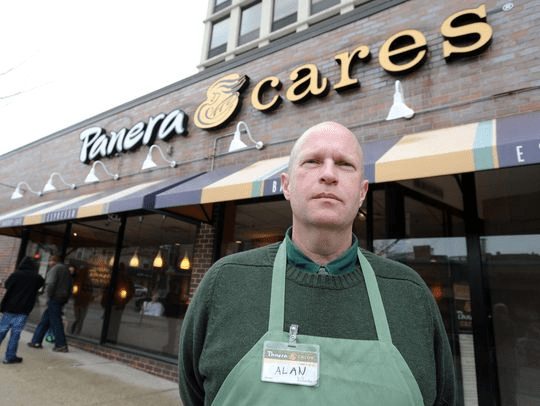
Alan Olsen at the Panera Cares cafe in Chicago, where he dines often and regularly as a volunteer. (Photo: Brett T. Roseman for USA TODAY)
The idea came after Shaich and his wife, Nancy, watched a TV news segment about a Denver entrepreneur who planned to open a cafe where diners paid only what they could afford. Shaich recalls his wife turning to him and asking, “Why don’t you do that?” Within a year, he did. He opened the first give-back-to-the-community store in the company’s hometown, St. Louis, in 2010. It’s still open — and still profitable. “It’s in our DNA,” says Shaich. “We didn’t get into business just to make money — not that that’s bad. We got into business to make a difference in the lives of our guests.” Panera Cares is now making that difference in five cities, with plans to expand to more. Alan Olsen eats two or three times a week — and volunteers once a week — at the Panera Cares in the Lincoln Park area of Chicago. “I like what they do,” says Olsen, who otherwise works as a waiter at an upscale restaurant in Chicago. “When I first saw Panera Cares, I wondered: How long is this going to last?” More than a year later, he no longer asks that. “It’s just good people with good hearts trying to give back.”
Nordstrom, too, has an eye on helping others with a Manhattan retail store, Treasure & Bond, whose profits — and sometimes, a portion of its sales receipts — go to charity.
Pete Nordstrom, president of merchandising and great-grandson of the Nordstrom chain’s founder, says he got the idea a few years ago when visited a store in Paris, whose proceeds all went to charity. “Companies have to do more than make money,” he says. “It’s one thing to do well by the number of customers and another thing to do well by the community.”
He opened a small store in New York’s swank SoHo district with three purposes: to test the New York market, where Nordstrom has no full-service department stores; to test selling merchandise that might not be sold in conventional Nordstrom stores; and to give back to the community. But kindness doesn’t always come easy — or cheap. The store has been running in the red since it opened, concedes Nordstrom. On top of that, it may have to change locations — or even close — after the lease expires in about six months. “We will keep doing this as long as we can make it work,” he says. “We have to balance making money and fulfilling our mission. “As long as the store is there, Jennifer Fisher will keep shopping there. She’s an upscale jewelry designer who works about five blocks away. In the past year, she’s spent about $1,000 purchasing gifts — mostly for others — at the store. The fact that a store like this is in business — with cool merchandise and a mindful purpose — is huge, she says. “Stores like this didn’t even exist before,” Fisher says. “It’s a no-brainer when you know that you can buy something special and, at the same time, know you’re giving back.”
Some companies have etched kindness into their core for decades and are glad to see others catching up. Among them: The Body Shop; Patagonia; Stonyfield; Timberland; and industry leader Ben & Jerry’s, which, in 1985, determined that 7.5% of its pre-tax profits would go to philanthropy. Since being purchased by global giant Unilever in 2000, the company has continued to give back roughly that same amount. “Anything that adds more kindness to the world is a good thing,” says co-founder Jerry Greenfield. “When companies measure social good at the same time they measure how much money they make, we’ll be in a better place.” But if the motivation for doing good is just about selling more stuff or making more money, it’s doomed to fail, warns Whole Foods’ Mackey, who recently co-authored a best-selling book on the topic, Conscious Capitalism. His natural foods grocery chain runs a foundation that grants loans to aid people in poverty in 55 countries trying to start small businesses. “We do these things because they’re the right thing to do.”
Starbucks has been at it for years. The coffee kingpin has operated a “community” store in New York’s Harlem district that’s been donating a fat chunk of its profits to local charities for more than seven years. More recently, it’s opened similar stores in Los Angeles and Houston. By 2018, it expects to operate 50 of these community stores.
Echoing others, CEO Howard Schultz says, “This can’t be done through a lens of marketing and PR, but through a lens of guiding principles.” Government simply can’t do everything, he says, “so it’s incumbent upon business leaders to do more than our share.” But it’s not just big, familiar brands doing the kindness thing. So, too, is the appropriately named KIND Healthy Snacks, a 10-year-old snack maker that claims to have both an economic and social bottom line. The company’s founder, CEO Daniel Lubetzky, was born in Mexico to a father who was a Holocaust survivor. That, he says, “defines who I am, I what I do.” His father’s suffering, he says, is the impetus for his company, whose core mission is to “build bridges between people.”
The key, he says, is that kindness must be genuine. His snacks, he says, not only help do kind things for the the body and the taste buds, but also the world. Every month, the company does one big act of kindness, such as buying school supplies for homeless children. At the same time, it prods its customers to do kind acts — as simple as writing a thank-you note to a former teacher — then report the act of kindness online. When enough customers report kind acts, the company responds, in kind, with a large act of kindness. “Young people don’t want to just make money,” says Lubetzky. “They want to make a difference.” Within two generations, he predicts, corporate kindness will be the rule, not the exception.
Just the image of kindness can be an effective sales tool. It’s no accident that one of Coca-Cola’s Super Bowl spots displayed a series of kind acts — such as dropped wallets being returned — as captured by security camera footage from around the globe. Fostering kind acts will become a bigger part of Coke’s marketing going forward, says Cristina Bondolowski, vice president of global brands. Extensive research shows that performing kind acts — the act of giving — makes people feel happier. Future marketing by Coke will show societal acts of kindness, such as a guy who installs swings in parks and a lady who secretly plants flowers at night. “This is not just telling people to be happy,” says Bondolowski, “but inspiring happiness.” The makers of Bayer aspirin have gotten in on the act, too. A recent TV spot for its Aleve pain relief brand features a guy whose back pain hits him while volunteering in a soup kitchen. The idea came from within the brand’s marketing group, which for the past four years has donated to — and had 100 people volunteer at — a local food bank near the company’s headquarters in New Jersey. “We’re just reflecting back to our consumers what they’re already doing,” says Barton Warner, vice president of marketing at Bayer Consumer Care U.S. There’s even a new magazine about this lifestyle that made its debut last month, appropriately named, Mindful. The first issue, with an initial circulation of 90,000, sold out, says editor-in-chief Barry Boyce. “When we are mindful, we not only reduce stress and enhance performance, but it increases our attention to the well-being of others.”
—
Are you familiar with the Social Progress Index?
Forget GDP. This index measures National Well-being!
http://www.fastcoexist.com/1681830/forget-gdp-the-social-progress-index-measures-national-well-being
—
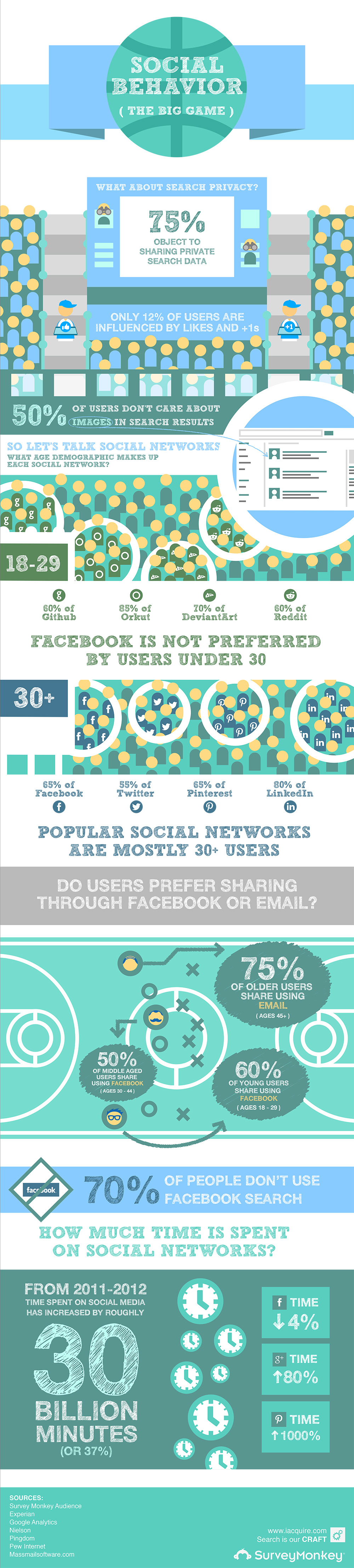
Social, Social, Social
Every wonder how social behavior has evolved?
This Social Behavior Infogram can help…
—
Personally speaking, it is great to work for an organization that has a double bottom line of financial performance AND social mission
https://www.missionfed.com/mission-possible-newsletter
—
Speaking of Externalities it is sometime nice to literally get outdoors to get some perspective on wonder and outer and inner nature…
Full moon in New Zealand
Here, an Australian output captured a huge full moon in New Zealand.
Australian Mark Gee video captured a stunning image of the moon looming on the viewpoint of Mount Victoria in Wellington (New Zealand). Within days, the video reached 110,000 views and is all the rage at Vimeo.
“People met up there tonight to have the best possible view of the moonrise. Capture video at 2.1kilometers away, on the other side of town,” said Gee in the video description.
According to the author, the material is as it was filmed without any manipulation.”It’s something I’ve wanted to photograph for a long time. There was a lot of planning and false starts,” he said. Is a video of about 3 minutes of incredible beauty
http://player.vimeo.com/video/58385453?autoplay=1
—
Triple Bottom Line Accounting means considering People, Planet and Profits.
Here is what my alma mater, UCSD is doing for Earth Week that might inspire you…
Students, staff and faculty at UC San Diego will celebrate environmental sustainability and the drive to create a healthy planet for future generations during the campus’s annual Earth Week celebration April 17 to 24. The theme for the series of planned events is “Making Zero a Reality,” illustrating the campus’s efforts to reduce its carbon footprint to have zero impact on the environment. Events will include a campus cleanup, documentary screening of “Bag It,” trash sort, sustainability awards ceremony, volunteer gardening opportunity and more.
“Earth Week at UC San Diego is an enduring tradition that exemplifies the campus’s commitment to creating a more sustainable future,” said UC San Diego Chancellor Pradeep K. Khosla. “Environmental sustainability is in UC San Diego’s institutional DNA; it is an integral part of our history and a top priority in our education, research and campus operations.”
Many of this year’s events are led by student sustainability organizations, including a guest appearance—sponsored by the Student Sustainability Collective—by Van Jones, former special advisor for green jobs in the Obama administration. Jones will be appearing with activist, environmentalist and former vice-presidential candidate Winona LaDuke; the two will discuss how issues relating to sustainability and social justice intersect.
Other student events include a trash sort, sustainability organization fair and campus cleanup.
“The ambition of our students is incredibly impressive,” said Kristin Keilich, sustainability manager at UC San Diego. “They continue to carry out the legacy of Roger Revelle and Charles David Keeling, whose work helped shape climate change research as we know it today. Our students are true examples of believing in and pushing for a better and more sustainable future by educating and developing innovative solutions.”
The campus community is invited to participate in all Earth Week events, which include the following. For more details, go to earthweek.ucsd.edu.
- “Bag It” Screening, noon to 1 p.m., Thursday, April 18, the Seuss Room at Geisel Library—This story follows Jeb Berrier, an average American guy who doesn’t consider himself as an environmentalist. He makes a pledge to stop using plastic bags. This simple action gets Jeb thinking about the many ways plastics are consumed. He embarks on a global tour to unravel how the use of plastics can be stopped.
- “Reduce your Waistline” Trash Sort, 10 a.m. to 1 p.m., Thursday, April 18, Library Walk—Students and staff will dig through more than 1,000 pounds of trash on Library Walk. The event will demonstrate how ordinary garbage contains recyclable items.
- Campus Clean Up, 11 a.m. to 2 p.m. Friday, April 19, begins at Town Square—San Diego Coastkeeper invites the UC San Diego community to help maintain the health of their campus and watershed, which drains to the La Jolla Shores, a state designated Area of Special Biological Significance.
- Pre-Earth Day at the Garden, 10 a.m. to noon, Sunday, April 21, Roger’s Community Garden—Roger’s Community Garden will hold special volunteer hours where anyone can come work on a unifying project that will contribute to the garden’s mission to green up the campus without using more water. This event will also feature gardening workshops where volunteers can learn about potting, soil selection and how to start seedlings.
- Van Jones and Winona LaDuke “Zero Injustice: Redefining Sustainability,” 7 p.m., Monday, April 22 (Earth Day), Price Center Ballroom East—Winona LaDuke and Van Jones will gather for a discussion on how sustainability is more than the development of clean technologies and business practices. The speakers will focus on how to redefine sustainability as a movement that addresses both environmental destruction and social inequality.
- E-Waste Collection, 7:30 a.m. to 3 p.m., Tuesday and Wednesday, April 23 to 24, outside the Student Services Center—Everyone is encouraged to bring old computers, stereos and cell phones to the corner of Rupertus Lane and Russell Lane between the Student Services Center and the Music Building. The e-waste will be reused, refurbished or recycled.
- Sustainability Awards, 3 to 4:30 p.m., Wednesday, April 24, the Loft—Chancellor Khosla will recognize individuals and groups that have made the UC San Diego campus more sustainable.
UC San Diego has gained a reputation for its sustainable efforts. The university was named as one of the most environmentally responsible colleges in the U.S. and Canada by The Princeton Review and received an A- grade in the Sustainable Endowment Institute’s “Sustainability Report Card.” In addition, UC San Diego was named the first college in California to earn a “gold” sustainability performance rating in the Sustainability Tracking Assessment and Rating System (STARS) survey.
For more information, go to http://sustainability.ucsd.edu.
We Rise by Lifting Others!
If all this Social Stuff is a little too heady, this social engagement should help you get the weekend off to a good start:
A little help over here, PLEASE… click here!
Thanks this week go to Vista Unified’ s Leadership team & Devin V., Alan D. , Roger S., Marlaine C., Mission Fed, Larry H., Heidi D., Pat D/A, UCSD & thee!
Pay it forward…
Love,
Neville
“The only thing of real importance that leaders do is to create and manage culture”
—Edgar Schein, Prof. MIT Sloan School of Management












 Happy Soul Food Friday!