“Have a good day, and even if you can’t have a good one,
don’t you dare go messing up nobody else’s.”- Tabitha Brown
If You are local-
Reflect. Reimagine. Recommit:
On November 6th we are hosting this event at Mission Fed HQ and invite all kindred spirits to join us as we both navigate the fierce urgency of now and invest in ourselves for the long game in this “next normal” for San Diego’s Nonprofit Workforce.
Why ADHD Causes Rage and Anger and How to Manage It: Certain ADHD symptoms may lead to outbursts of anger, including impulsivity and problems regulating emotions. Some triggers for anger include rejection, overstimulation, fatigue, frustration, and abrupt transitions.
Humans’ Hidden “Sixth Sense” To Be Mapped Following $14.2 Million Prize – What Is Interoception? The team aims to create the first atlas of this internal sensory system.
The simple 5-minute bedtime yoga pose one expert swears by to beat insomnia: Stop counting sheep! We reveal the simple, expert-recommended yoga pose that cuts stress, preps your body for sleep and beats insomnia without medication Mon, 20 Oct 2025 If you find yourself waking up during the night or have trouble falling asleep in the first place, practicing yoga may be the solution you need. It helps you relax any time of day, improves your flexibility and is an excellent tool to reduce stress and anxiety and prepare your body for sleep
How Charlie Chaplin used his uncanny resemblance to Hitler to fight fascism
Happiness researcher reveals the ‘enduring’ secret to being happy in the second half of life
Yoga vs Aerobic exercise: Which is better for heart health?
18 triumphant images from the 1839 Photography Awards
How Charlie Chaplin used his uncanny resemblance to Hitler to fight fascism: It’s been 85 years since The Great Dictator first dazzled audiences in 1940. It was a big risk for one of the world’s most popular performers to take a stand against fascism on film.
Happiness researcher reveals the ‘enduring’ secret to being happy in the second half of life: It goes against what Mother Nature may be telling you. 10.15.25 Happiness researcher Dr. Arthur Brooks says that one of the most important things people can do as they enter the second half of their life is to focus on internal well-being rather than satisfying all of their wants. Even though this may feel like it runs counter to how many live the first half of their lives, he says it’s the best way to find joy in middle age and beyond.
Yoga vs aerobic exercise: Which is better for heart health? For many, modern life has turned into a chair-bound marathon. Footsteps fade, finger taps rise, and prolonged stillness emerges as a silent threat to public health. Such sedentary lifestyles are fueling a surge in chronic illnesses, including heart disease, diabetes, obesity, and cancer. Beneath the surface, the body’s metabolic machinery falters: insulin loses its edge, blood vessels stiffen, and lipid profiles go rogue.
18 triumphant images from the 1839 Photography Awards: 18 triumphant images from the 1839 Photography Awards Our great big world captured in beautiful detail. In 1839, photography as a medium was made widely available to the public. And the world changed. Named in honor of photography’s milestone year, the 1839 Awards celebrates stunning imagery from around the world. This year’s competition welcomed entries from 79 countries and awarded winners across professional and non-professional categories
This past weekend some of us were discussing this salient topic.
If F.E.A.R = False, Evidence, Appearing Real
And Hope/Faith is “the substance of things to come, the evidence of things not yet seen”
Coupled with the Serenity Prayer inviting us to discern the difference between what we can and cannot change:
“God, grant me the serenity to accept the things, I cannot change the courage to change the things I can and the wisdom to know the difference.
Living one day at a time, enjoying one moment at a time. Accepting hardships as the pathway to peace. Taking, as he did, the sinful world as it is, not as I would have it. Trusting that he will make all things right if I surrender to His will; that I may be reasonably happy in this life, and supremely happy with Him forever.”
Jim Collins, in “Good to Great” invites us to confront the brutal facts, but always maintain hope:
Every good-to-great company embraced what we came to call the “Stockdale Paradox”: you must maintain unwavering faith that you can and will prevail in the end, regardless of the difficulties, and at the same time, have the discipline to confront the most brutal facts of your current reality, whatever they might be.
And Beloved Viktor Frankl reminds us of the choice that lies between stimulus and response:
“Between stimulus and response there is a space. In that space is our power to choose our response. In our response lies our growth and our freedom.” –Viktor Frankl
Hope is Not a Strategy:
What Does It Mean?
Hope will only get you so far. You cannot just wish away your (or the country’s) problems. There needs to be a concentrated effort to reduce problems and to increase positive opportunities. Just sitting around thinking about how the current situation could be better is not going to change anything, you also must act.
Certainly, hope and prayer can work in the face of a difficult situation, but you need to be prepared to do your part to assist in the completion of the goal as well.
Not to mention the Last Thing in Pandora’s Box:
The last “evil” in Pandora’s Box: Hope.
Was it a blessing or a curse? Here, I think more about Hope and how we can reframe it to unleash its power to shape a better future.
This morning, I was discussing clutching to expectations – and what happens when we mistake them for agreements with the universe.
If you’re inclined do reflect more on this discussion, read on…
About ten years ago, I was preparing a retreat in the mountains. I put my customary effort into setting up a meaningful schedule, food, and space. I smiled at my mental picture of people arriving softened by the landscape, ready to drop in. Maybe a few tears. Definitely some gratitude.
Then the first three folks walked in.
They looked tense. Distracted. One person asked if there was WiFi. Another frowned at her seating location like I’d personally betrayed her. And I felt it – my chest tightened, my stomach seemed a bit hollow. That unspoken internal oh.
I didn’t just prepare a retreat. I built a vision of how it should go. And reality, as it does, showed up differently.
The retreat unfolded beautifully, by the way. People softened. Insights came. But my first task was to let go of the version I’d been clutching, of my expectation.
We live in a field of expectations. We expect the coffee to brew. The light to turn green. The message to go thru. The emotion to pass. The body to cooperate. The person to understand.
Most of the time, these expectations are quiet, useful, and help us move through the world. We expect chairs to hold us. We expect that when we speak, someone might listen.
But then there are the other kind. The ones where expectation tips into attachment. Where we go from I hope this happens to It must happen this way, or I can’t be okay/I wont’ be okay.
That’s when the wobble starts.
In Buddhist teaching, this wobble is called dukkha. It’s often translated as “suffering,” but I think a better word is unsatisfactoriness. Stress. Dis-ease. The sense that something’s just… off.
The word is Pali, made up of Du – bad/difficult, and Kha – the axle hole in a wheel. The image is of an old timey wooden cart with a messed-up wheel. No matter how smooth the road, the wheel wobbles. The ride is never quite right – it’s unsatisfying.
Life is like that. Full of bumps and misalignments. Small or large. And yet, the practice approach isn’t to force the ride to be smooth. It’s to notice the wobble – and soften around it. To stop white-knuckling the reins. To sit back and breathe. This, by the way, is radical. It is unamerican. It is also deeply sane.
Because here’s the thing: expectation itself isn’t the problem. It’s the attachment. The demand that it go a certain way. The belief that our peace depends on it. That our identity is synonymous with it.
And when we catch that – when we notice the clench – we have a choice.
You know these moments in the brief meditation time you spend. Your thoughts: I should be more focused by now. Or: I shouldn’t still feel this way. Or: They should have responded. Or: It shouldn’t have said that.
Each one is a little bump in the wheel. A moment of dukkha.
But each one is also a gate. A small opening where awareness can slip in through the ego chatter.
I’ve learned to catch these moments – not perfectly, but more often. And when I do, I ask myself a simple question: What was I hoping for?
Sometimes the answer is obvious. Sometimes it surprises me. Maybe I was hoping for ease. For validation. For a different ending. For my body to feel better. For someone to get it.
And then I try something that sounds almost too simple to work, but it does: I soften the grip.
I don’t abandon the hope. I don’t pretend I don’t care. I just… loosen my fist around it.
I might say to myself: I care – but I don’t mind. Or: It’s okay if it’s not like that. Or one of my favs: May I meet this gently.
And my body responds. My shoulders drop. Something unclenches. The wobble is still there, but I’m not fighting it anymore.
So, here’s what I’m inviting you to try this week – a small inquiry you can use when you feel that tightness, that oh, that sense of something being off, that disappointment.
1.Name the experience. Objectively label the thought: Disappointment is here. Or: Ouch. Or: Not what I expected. Or just, Disappointed. Noting and labeling create space. This takes the charge down a notch.
2.Trace the expectation. Ask yourself (curiously, not accusatorial): What was I hoping for? What did I assume would happen? Let the answer arise. Maybe it was peace. A thank you. A different result. Just notice it.
3.Soften the attachment. Breathe into one of these phrases (or your own version): I care… but I don’t mind. It’s okay if it’s not like that. May I meet this moment gently. Let your body feel the refocus – from tension to presence.
This isn’t about forcing yourself to be okay with everything. It’s not spiritual bypassing. It’s just… making a little more room for things to be as they are.
I don’t know how to stop hoping. I don’t want to. You can still love, plan, prepare, dream. You can pour yourself into retreats and relationships and projects.
But the question is: Can you also let go when it doesn’t land the way you imagined?
Can you embrace reality as it is because it is the only reality that can be?
Can you sit back into the wobble and ride it with a little more grace?
“What if economics didn’t start with money but with human wellbeing”? Join us as we Developing the SD County Doughnut:
On Thursday, I was part of a panel at Cause SD on Doughnut Economics and why are current models are simply not cutting it.
If this work interests you, let me know and we can add you to the list..
Doughnut economics creator Kate Raworth and Janine Benyus – a biologist and leading figure in biomimetic design – discuss how starting from the whole can allow us to build systems and structures that help us to thrive. This conversation was originally presented at Equilibrium.
Equilibrium brought together interdisciplinary artists, campaigners, and thinkers to address questions of environmental justice and the role of culture in creating it, part of Radical Ecology x Back to Earth Live.
This vid reminds us of the fragility of humans and the steadfastness of mother earth and why we must live in harmony or face the consequences at our own undoing.
The world’s oldest and largest iceberg will soon be no more: The iceberg, known as A23a, has been on a journey following the current into warmer waters for months. Now, it has begun the predicted and natural process of breaking apart and eventually melting.
Designers create incredible tech that can attach to surfboards and kayaks — here’s how it could help solve major problem in our oceans: It has already won multiple awards. Oct 02, 2025, As we continue to fight against microplastic pollution, a team of engineers has created an innovative solution that could have a massive impact through an unexpected activity: water sports. According to Design Wanted, three graduates from IED Milan created Hauki, a project that turns board sports like surfing into microplastic cleanup efforts. Hauki is a system that attaches to surfboards, paddleboards, and canoes, and captures microplastics
Selections From the 2025 Audubon Photography Awards Top 100: Contest organizers from this year’s Audubon Photography Awards shared some of their Top 100 selections—featuring a ringed kingfisher, a yellow-eared parrot, whooper swans, and more.
“Mom, you’re not going to believe what happened in history class today.”
Her teacher told the class they were going to play a game.
He walked around the room and whispered to each kid whether they were a witch or just a regular person. Then he gave the instructions:
“Form the biggest group you can without a witch. If your group has even one, you all fail.”
She said the whole room instantly lit up with suspicion.
Everyone started interrogating each other. Are you a witch? How do we know you’re not lying?
Some kids clung to one big group, but most broke off into smaller, exclusive cliques. They turned away anyone who seemed uncertain, nervous, or gave off even the slightest hint of being guilty.
The energy shifted fast. Suddenly everyone was suspicious of everyone.
Whispers. Finger-pointing. Side-eyes. Trust dissolved in minutes.
Finally, when all the groups were formed, the teacher said,
“Alright, time to find out who fails. Witches, raise your hands.”
And not one hand went up.
The whole class exploded. “Wait! You messed up the game!”
And then the teacher dropped the bomb:
“Did I? Were there any actual witches in Salem, or did everyone just believe what they were told?”
My daughter said the room went dead silent.
That’s when it hit them. No witch was ever needed for the damage to happen. Fear had already done its work. Suspicion alone divided the entire class, turning community into chaos.
And isn’t that exactly what we’re seeing today?
Different words, same playbook.
Instead of “witch,” it’s liberal, conservative, vaxxed, unvaxxed, pro-this, anti-that.
The labels shift, but the tactic is the same.
Get people scared. Get them suspicious. Get them divided.
Then sit back while trust crumbles.
The danger was never the witch.
The danger is the rumor. The suspicion. The fear. The planted lies.
Refuse the whisper. Don’t play the game. Because the second we start hunting “witches,” we’ve already lost.
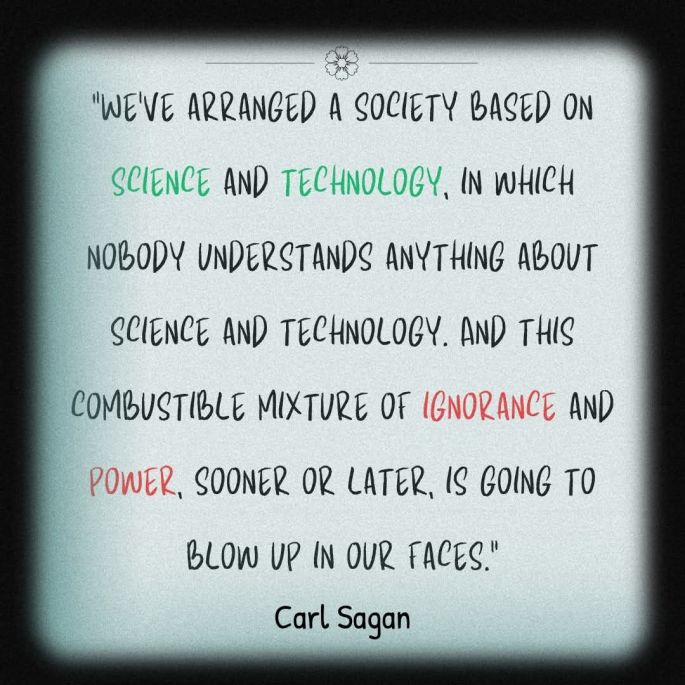
Science and Technology:
“We’ve arranged a society on science and technology in which nobody understands anything about science and technology, and this combustible mixture of ignorance and power sooner or later is going to blow up in our faces. I mean, who is running the science and technology in a democracy if the people don’t know anything about it? Science is more than a body of knowledge; it’s a way of thinking. If we are not able to ask skeptical questions to interrogate those who tell us something is true, to be skeptical of those in authority, then we’re up for grabs for the next charlatan political or religious leader who comes ambling along. It’s a thing that Jefferson lay great stress on. It wasn’t enough, he said, to enshrine some rights in the Constitution and the Bill of Rights, the people had to be educated and they have to practice their skepticism and their education. Otherwise, we don’t run the government, the government runs us. —Carl Sagan”
I’ve spent my entire career studying stress—the No. 1 cure for it might ‘surprise’ you: Stress expert Rebecca Heiss says that the advice we so often get about how to relieve stress is ‘completely wrong.’ If you want to feel better, rather than turning inward, think about how you can contribute to your community instead.
Ocean Photographer of the Year 2025 Finalists: The finalist selections in this year’s Ocean Photographer of the Year competition were just revealed by contest organizers at Oceanographic Magazine, and feature some of the best coastal, drone, and underwater photographs chosen from thousands of submissions.







 Happy Soul Food Friday!